
Last Updated: 5 months ago
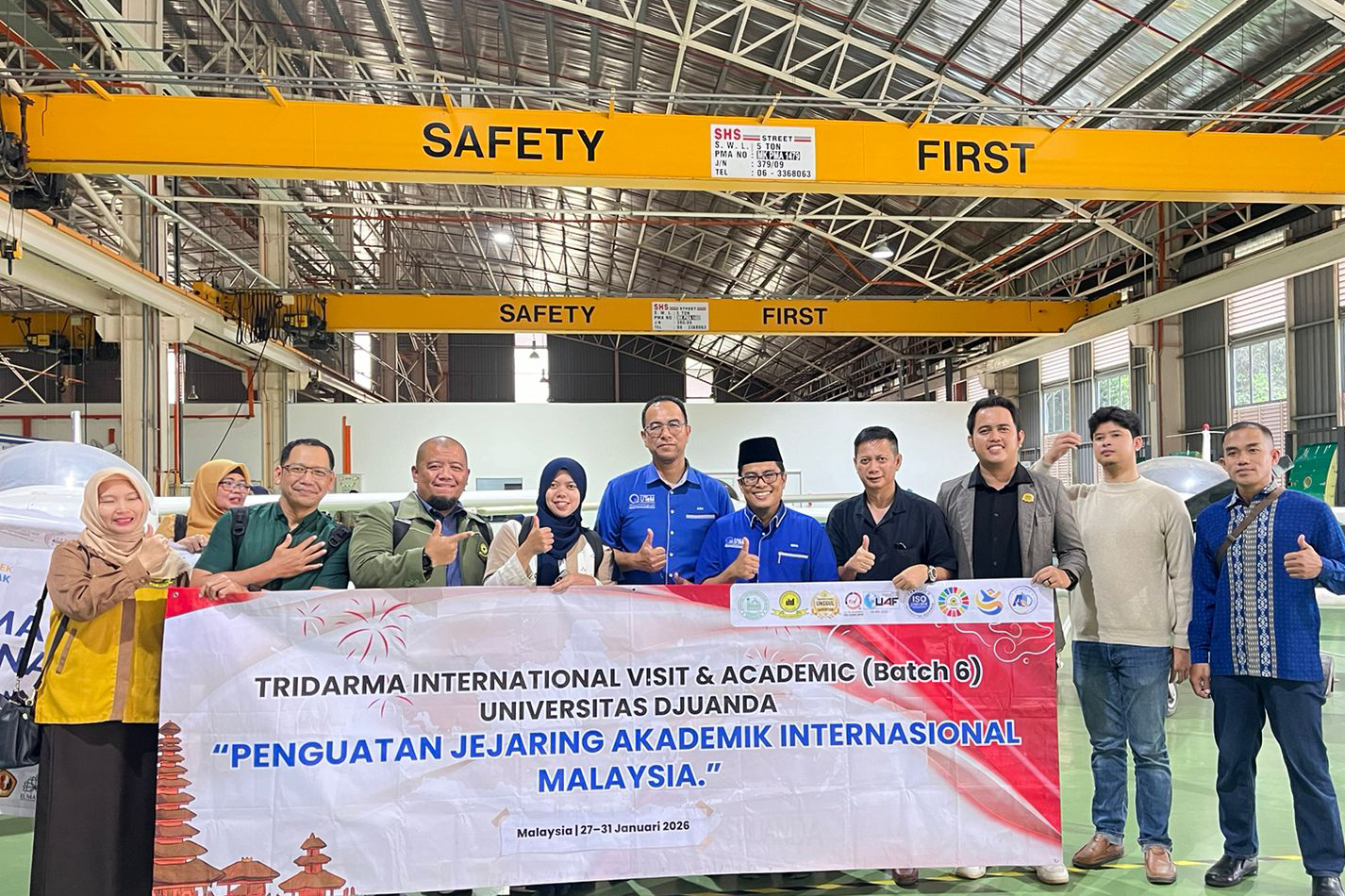
MELAKA, January 29, 2026 – The Tridharma International Visit & Academic (Batch 6) program of the Faculty of Social and Political Sciences (FISIP), Universitas Djuanda (UNIDA), continued with a strategic visit to Universiti Teknikal Malaysia Melaka (UTeM) on the second day in Melaka. Carried out under the theme “Strengthening International Academic Networks in Malaysia,” the FISIP UNIDA delegation undertook a Courtesy Visit, an Academic Meeting discussing ASEAN-related issues, and an on-site review of UTeM’s Aircraft Industry Factory and Drone Technology facilities.
This visit marked a progressive step for FISIP UNIDA to observe how higher education institutions manage the downstreaming of technological innovation—serving as a tangible case study relevant to the development of administrative science and public policy.
The activities at UTeM constituted a strategic implementation of Key Performance Indicators (KPIs), particularly KPI 6 (Study Program Partnerships) and KPI 3 (Lecturers Engaged Outside Campus). By directly reviewing strategic industries within the campus environment, FISIP UNIDA strengthened the vision of the Impactful Campus Program. This demonstrates that social and political sciences do not stand alone; they provide governance and policy frameworks that support technological advancement for the benefit of society.
Dean of FISIP UNIDA, Dr. Hj. Rita Rahmawati, Dra., M.Si, emphasized the importance of this cross-disciplinary visit in broadening academic horizons.
“The visit to UTeM and its aircraft and drone industry facilities has opened our eyes to the fact that social sciences must move in tandem with technological progress. We are not learning how to assemble machines, but how this innovation ecosystem is governed and how institutional policies can foster industrial self-reliance. This strengthens our academic network with a more comprehensive and insightful perspective,” she said.
Dr. Rita further highlighted the direct benefits of the visit for research and teaching development within the faculty.
“For FISIP lecturers, firsthand exposure to the governance of high-technology industries provides exceptionally rich research material. We aim to ensure that our curriculum and research remain adaptive to contemporary challenges. Understanding the social impacts and regulatory aspects of drone technology, for example, reflects our commitment to positioning FISIP as part of an Impactful Campus that is responsive to global issues,” she added.
Meanwhile, Head of the Public Administration Study Program at FISIP UNIDA, Faisal Tri Ramdani, S.Sos., M.A.P, viewed the visit through the lens of collaborative governance.
“From a Public Administration perspective, what UTeM has achieved with its aircraft and drone industries is a concrete example of a successful collaboration model between academia and industry. This serves as highly valuable benchmarking for us in designing public policies and organizational governance capable of stimulating innovation. This is the type of management model we aim to study and adapt for future program development,” Faisal explained.
Following the agenda at UTeM, the FISIP UNIDA delegation will continue preparations for presentations at the ASEANACA International Conference (6th ICOSTELM 2026), as well as activities related to international community service.