
Last Updated: 2 months ago
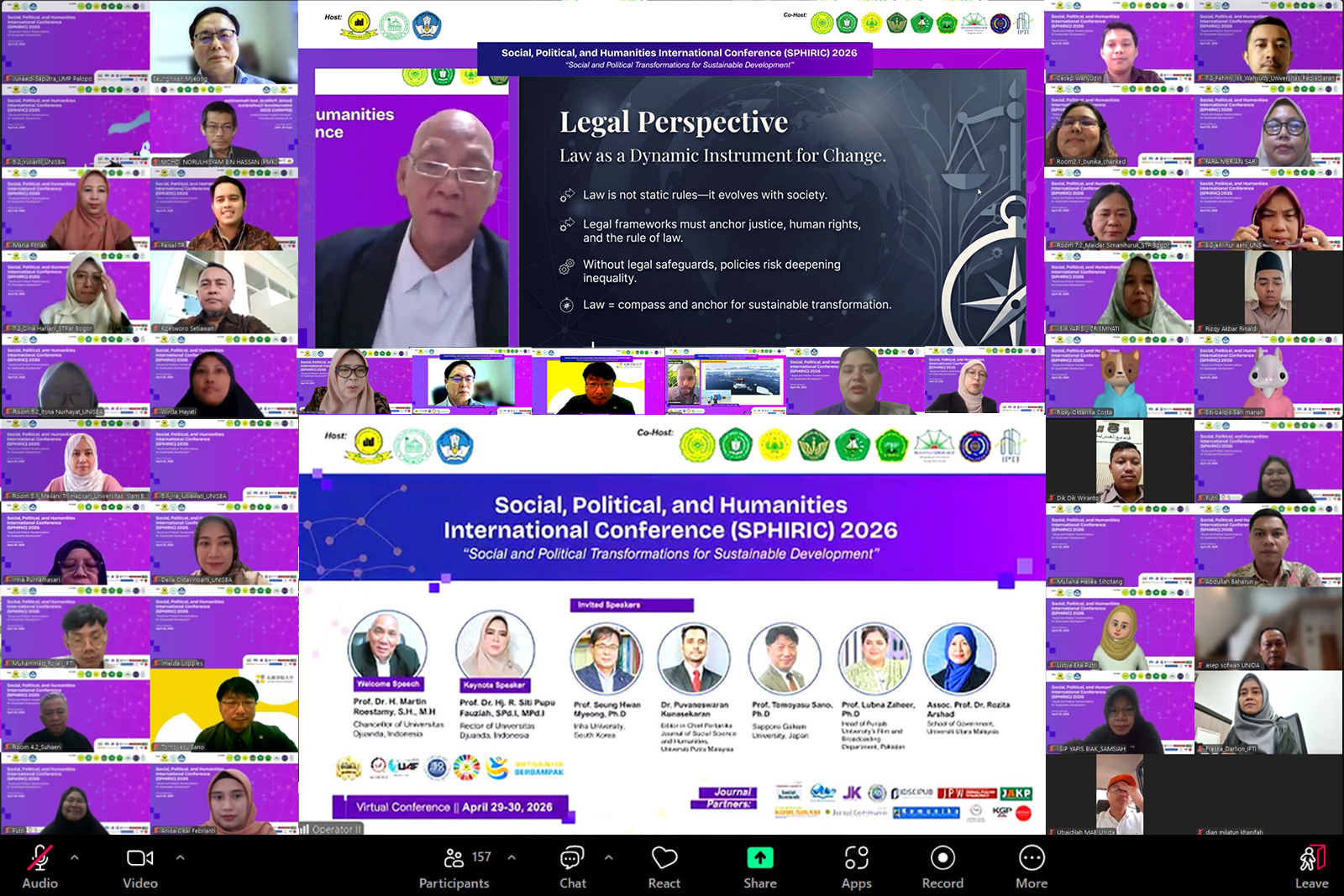
Bogor – The Faculty of Social and Political Sciences (FISIP) at Universitas Djuanda once again demonstrated its commitment to strengthening global academic networks through the organization of the Social, Political, and Humanities International Conference (SPHIRIC) 2026 on April 29, 2026. The international conference, themed “Social and Political Transformations for Sustainable Development,” became a platform for interdisciplinary and cross-country collaboration by bringing together academics, researchers, students, and practitioners from various parts of the world.
SPHIRIC 2026 was attended by 255 participants from 57 domestic and international institutions, consisting of 241 presenters and 14 non-presenters, reflecting the high enthusiasm of academics and researchers toward the international scientific forum. Through this event, FISIP UNIDA also encouraged the production of academic outputs in the form of international proceedings, nationally accredited journals, and Scopus-indexed book chapters published by UPM Press. The conference was held in collaboration with nine co-host institutions: Universitas Muhammadiyah Jakarta, Universitas Mathla’ul Anwar Banten, Universitas Pakuan, Universitas Ibn Khaldun Bogor, Sekolah Tinggi Pariwisata Bogor, Universitas Lancang Kuning, IISIP YAPIS Biak, Institut Pariwisata Tedja Indonesia, and Universitas Muhammadiyah Palopo, as part of a synergy to strengthen academic networks and enhance the quality of research and scientific publications at national and international levels.
Dean of FISIP UNIDA and Chairperson of SPHIRIC 2026, Assoc. Prof. Dr. Hj. Rita Rahmawati, stated that SPHIRIC 2026 marked a concrete step in strengthening the role of universities as centers of academic collaboration and innovation.
“Through this event, we hope to foster the exchange of knowledge, experiences, and research findings that can provide tangible contributions to society and sustainable development,” she said.
She added that the international conference also served as an important opportunity to expand collaboration networks among universities, researchers, and practitioners from various countries.
In addition to featuring the Rector of Universitas Djuanda, Prof. Dr. Hj. R. Siti Pupu Fauziah, as the Keynote Speaker with her presentation titled “Reimagining Guidance and Counseling Management: A Human Resource Development Approach to Achieve the SDGs,” SPHIRIC 2026 also welcomed five international speakers who discussed strategic issues ranging from digital transformation and mental health to democracy and indigenous community development through sustainable tourism. Their presence further strengthened SPHIRIC’s position as an academic forum responsive to today’s global challenges.
Assoc. Prof. Dr. Rozita Arshad from the School of Government, Universiti Utara Malaysia, in her presentation titled “Integrating Entrepreneurship and Public Policy in Urban Development,” emphasized that the connection between entrepreneurship and public policy can no longer be separated.
“Entrepreneurship cannot be detached from public policy. The synergy between the two will determine the direction of urban transformation,” she stressed.
She added that close collaboration between governments and business actors can create urban ecosystems that are more responsive to global economic changes.
Meanwhile, Prof. Seung Hwan Myeong from Inha University, South Korea, reminded participants that digital government transformation cannot succeed by relying solely on technology. In his presentation titled “Digital Bureaucracy and Citizen Participation,” he emphasized that organizational capacity, adaptive leadership, and active citizen participation are the true keys to success.
“Digital bureaucratic transformation will fail without strong leadership and genuine public participation. Technology is merely a tool, not the goal,” he stated.
He also added that openness and citizen participation are the main foundations of transparent and effective governance in the digital era.
Taking a different perspective, Prof. Tomoyasu Sano from Sapporo Gakuin University, Japan, presented a clinical psychology perspective through his topic, “Clinical Psychological Considerations for People Who Cannot Adapt to Change: Supporting the Return to Work of Patients with Depression.” He encouraged all parties not to underestimate individuals who struggle to adapt to change.
“The inability to adapt is not a weakness, but rather part of an individual’s character that deserves respect and support,” he explained.
He emphasized that supportive work environments and social support systems are crucial factors in the successful recovery of depression patients returning from sick leave.
In her presentation, Prof. Lubna Zaheer from Punjab University, Pakistan, highlighted the crucial role of media in maintaining public trust amid the rapid flow of information and the spread of misinformation. In her topic “Media, Democracy and Public Trust,” she stressed that media can only serve as the glue of democracy when it prioritizes credibility and transparency.
“Media becomes the glue of democracy when it dares to be honest and transparent. In times of crisis like today, public trust cannot be bought, but it can be built through responsible journalism,” she emphasized.
According to her, media professionalism in filtering information and combating misinformation is key to democratic stability.
Lastly, Dr. Puvaneswaran Kunasekaran from Universiti Putra Malaysia, who also serves as Editor-in-Chief of Pertanika Journal of Social Science and Humanities, presented “Tourism as a Sustainable Community Development Tool for Indigenous People in Malaysia.” He offered a different perspective on sustainable tourism by emphasizing that tourism can never create real impact if indigenous communities are treated merely as objects of attraction without full participation.
“Fair and sustainable tourism is only possible when indigenous communities become the main actors, not merely properties on a stage,” he stated.
He added that the active involvement of local communities not only generates economic benefits but also serves as the strongest safeguard for preserving cultural identity.
All plenary sessions were moderated by Afmi Apriliani, who guided the academic discussions interactively and dynamically. The conference also continued with parallel sessions featuring hundreds of presenters from universities both in Indonesia and abroad.
Through SPHIRIC 2026, FISIP UNIDA once again reaffirmed its role as a higher education institution actively building international collaboration, improving the quality of scientific publications, and encouraging meaningful academic contributions toward sustainable development in Indonesia and globally.