
Last Updated: 6 months ago
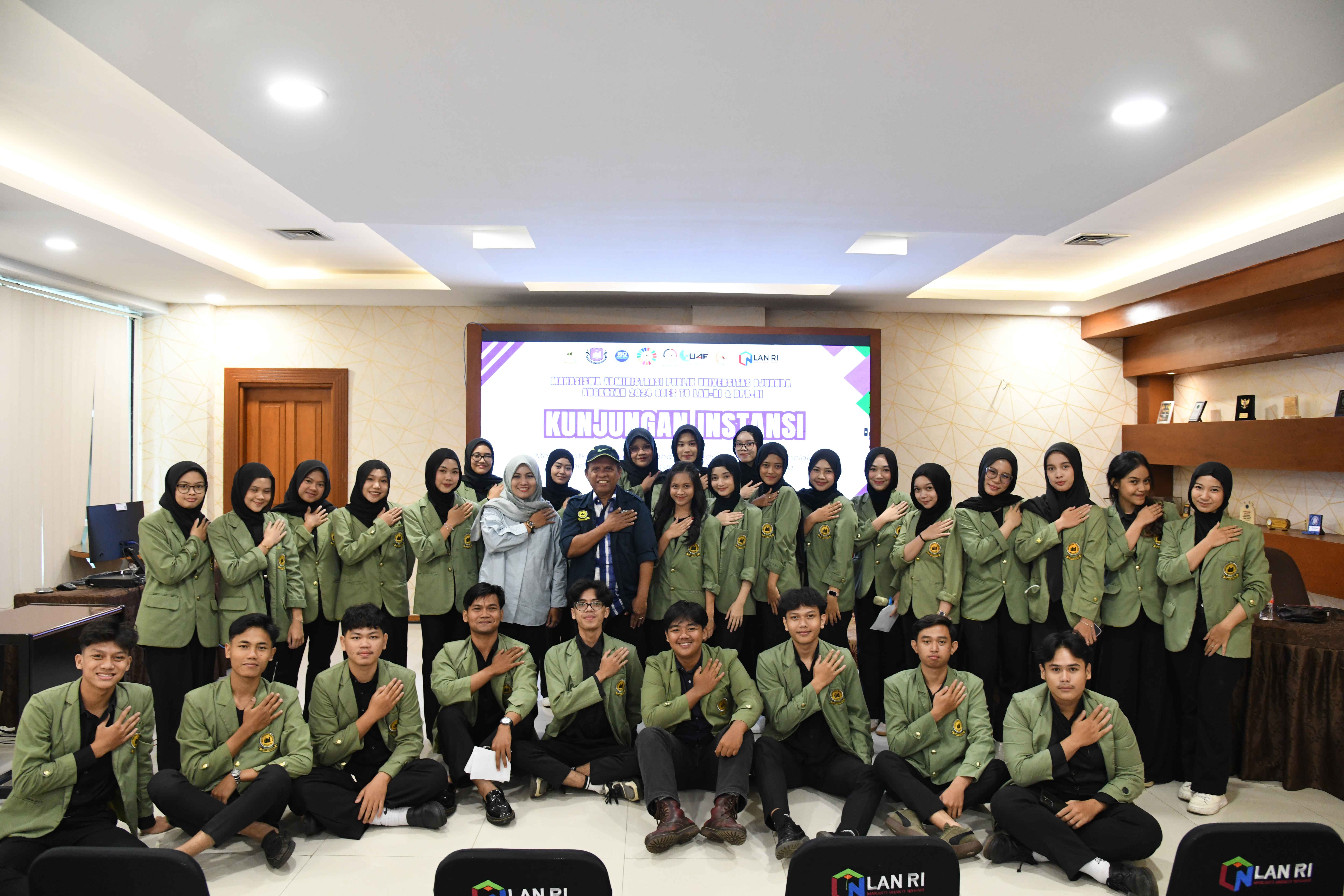
The Public Administration Study Program, Faculty of Social and Political Sciences (FISIP), Universitas Djuanda (UNIDA), continues to strengthen practice-based learning through the Practitioner Teaching Program in the State Administration System course. The activity was held on Tuesday, January 6, 2026, at the National Institute of Public Administration (LAN) of the Republic of Indonesia.
The Practitioner Teaching session featured Isni Kartika Larasati, S.Pd., M.Si, a Policy Analyst at the Directorate of Strategy for Improving the Quality of State Administration Policy, LAN RI, who served as a practitioner lecturer and delivered material entitled “When the Government Must Be Present: The Role of Public Administration for Society.”
Dean of FISIP UNIDA, Dr. Hj. Rita Rahmawati, Dra., M.Si, stated that the presence of practitioners from strategic government institutions such as LAN adds significant value to the student learning process.
“Through this Practitioner Teaching activity, students gain a real picture of how state administration and public policy are implemented in practice. Learning becomes more contextual and relevant to current governance challenges,” she said.
Dr. Hj. Rita Rahmawati, Dra., M.Si, added that collaboration between universities and government institutions is part of FISIP UNIDA’s commitment to improving the quality of graduates who possess both strong academic understanding and practical insight.
“Institutionally, this activity also strengthens the synergy between UNIDA, particularly the Public Administration Study Program of FISIP, and the National Institute of Public Administration of the Republic of Indonesia. This collaboration is expected to continue to develop through academic cooperation and other forms of contextual learning,” she added.
Meanwhile, in her presentation, Isni Kartika Larasati, S.Pd., M.Si, explained that the presence of the state cannot be understood merely as a normative concept, but must be realized through responsive public policies, equitable public services, and bureaucratic performance oriented toward public interests.
“The government must be present through policies that are able to address public issues. Therefore, the policy formulation process needs to be supported by data, comprehensive analysis, and an understanding of the policy’s impact on society,” she explained.
Isni Kartika Larasati, S.Pd., M.Si, also highlighted the strategic role of policy analysts in ensuring the quality of state administration policies so they can respond to various public challenges.
“Public administration functions as a bridge between state objectives and policy implementation. When the administrative system functions well, public services can be tangibly felt by the community,” she emphasized.
The activity was conducted through material presentations, interactive discussions, and public policy case studies. Students were encouraged to understand the role of public administration as a strategic instrument in addressing public needs and managing various policy and bureaucratic challenges, as well as service quality.
One of the participants, Muthia Agnia Ridzky, a 2024 cohort student of the Public Administration Study Program, said that the activity provided a learning experience different from regular lectures. She hopes similar activities will continue to be implemented so that students gain a comprehensive understanding of the role of public administration in realizing effective, responsive, and public-oriented governance.
“The material presented really broadened our perspective because it was directly linked to public policy practice. We now better understand how state administration roles are carried out in real terms by the government,” she said.