
Last Updated: 6 months ago
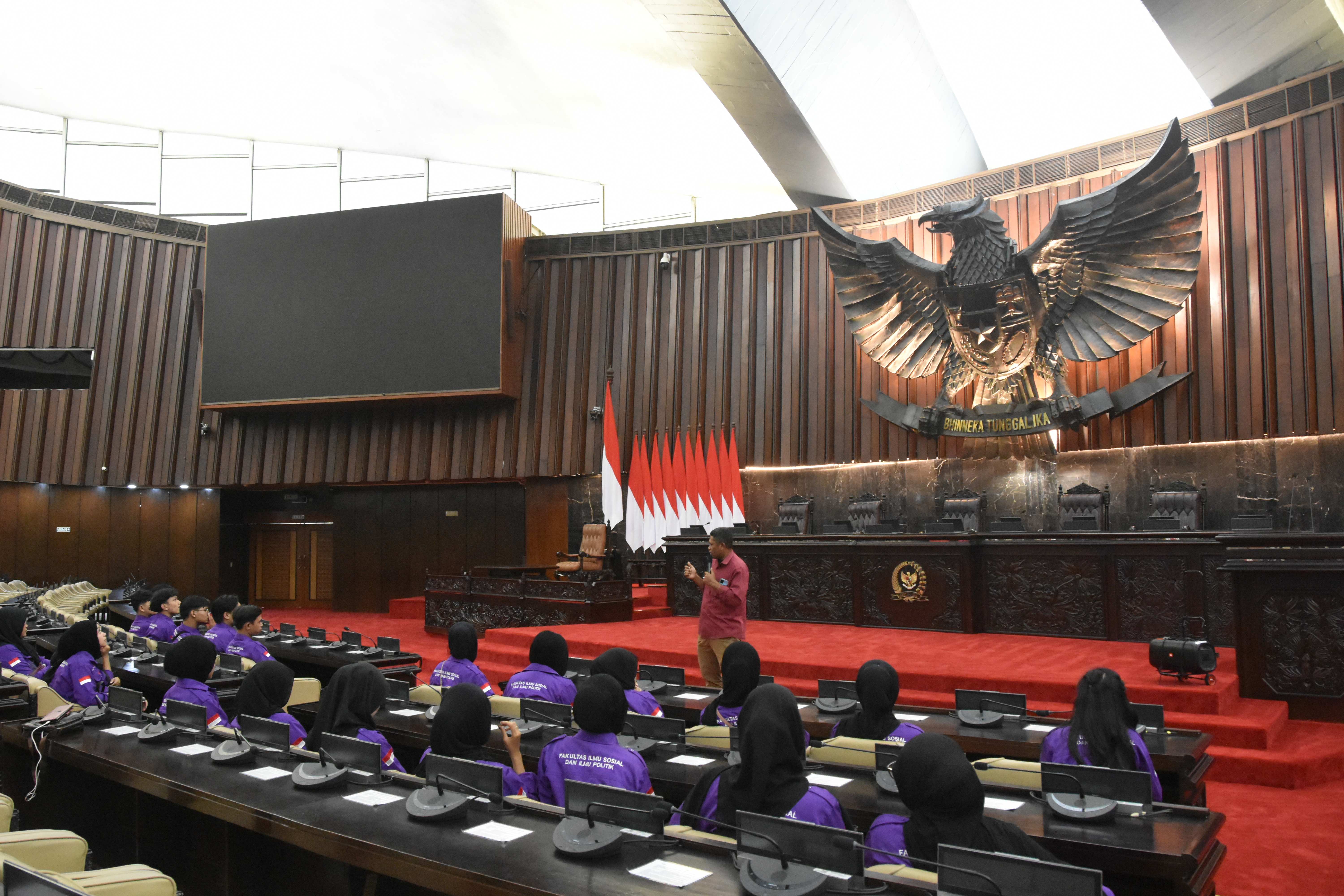
Sciences (FISIP), Universitas Djuanda (UNIDA), Class of 2024, conducted an academic visit to the House of Representatives of the Republic of Indonesia (DPR RI) on Tuesday, January 6, 2026.
This activity was part of the State Administration System course, designed as contextual learning to deepen students’ understanding of the legislative process, oversight functions, and the role of the DPR RI within Indonesia’s system of governance.
Dean of FISIP UNIDA, Dr. Hj. Rita Rahmawati, Dra., M.Si, stated that the academic visit holds strategic value in the learning process of Public Administration students. Through this activity, students are encouraged to engage in experiential learning as part of efforts to develop Public Administration graduates with a comprehensive understanding, a critical mindset, and readiness to contribute to future governance and public service.
“This visit to the DPR RI serves as a direct learning platform for students to understand real practices of governance and public policy. Students are expected to gain factual insights into the legislative process and the implementation of representative functions carried out by the legislative institution,” she said.
In line with this, Dr. Muhamad Husein Maruapey, Drs., M.Sc, the lecturer in charge of the State Administration System course who also accompanied the visit, emphasized that the activity was designed to strengthen students’ critical perspectives on governance.
“We hope students are able to connect classroom materials with the realities they encounter in the field, particularly regarding the role of legislative institutions in public policy formulation,” he explained.
During the visit, students received direct explanations regarding the working mechanisms of the DPR RI, its institutional structure, and the dynamics of public policy formulation at the national level. One of the participating students, Intan Hastari Prasetiani, shared that she gained valuable experience from the visit.
“This visit provided a clearer picture of how the DPR RI operates. We were able to directly understand the decision-making process and the role of people’s representatives in voicing public aspirations,” Intan said.