
Last Updated: 6 months ago
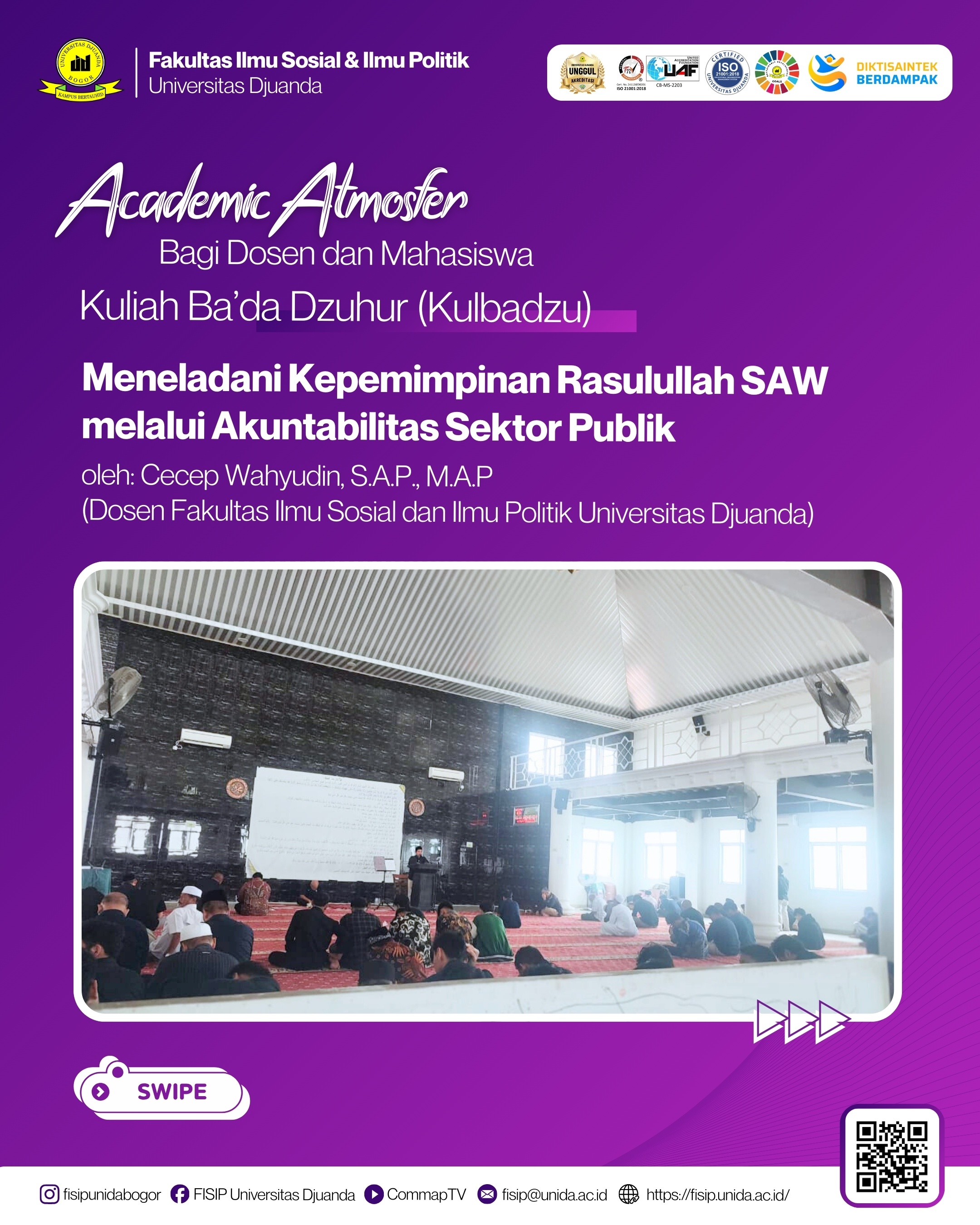
Academic Atmosphere for Lecturers and Students
Ba‘da Dhuhr Lecture (Kulbadzu)
By: Cecep Wahyudin, S.A.P., M.A.P
(Lecturer, Faculty of Social and Political Sciences, Universitas Djuanda)
Thursday, January 6, 2026
In the life of a nation and state, public leadership plays a highly strategic role. Leaders in government institutions, community organizations, and private institutions alike all bear a great trust from the people and, more importantly, a trust from Allah SWT. Therefore, public sector accountability is not merely an administrative concept, but a moral and spiritual value that is deeply aligned with Islamic teachings.
On this occasion, we would like to share insights on “Emulating the Leadership of the Prophet Muhammad (PBUH) through Public Sector Accountability.”
Accountability as a Trust (Amanah) in the Qur’anic Perspective
Allah SWT emphasizes the importance of trust and responsibility in the Qur’an:
“Indeed, Allah commands you to render trusts to whom they are due, and when you judge between people, to judge with justice.”
(Qur’an, An-Nisa: 58)
This verse affirms that power and position are a trust, not a privilege. In the context of the public sector, this trust means that every policy, budget, and public service must be accountable in a transparent and fair manner.
The Prophet Muhammad (PBUH) as a Model of Accountable Leadership
Distinguished audience,
The Prophet Muhammad (PBUH) is a concrete example of a leader who was fully accountable—not only to humanity but also to Allah SWT. In a hadith, the Prophet (PBUH) said:
“Each of you is a leader, and each of you will be held accountable for your leadership.”
(Narrated by Bukhari and Muslim)
This hadith conveys a profound meaning that public leadership is a responsibility that will be questioned, both in this world and in the Hereafter. There is no room for abuse of power, corruption, or neglect of public interests.
Transparency and Honesty in the Leadership of the Prophet
The Prophet Muhammad (PBUH) was known as Al-Amin, the most trustworthy. In managing public assets, he demonstrated extraordinary transparency. When suspicion arose regarding the distribution of war spoils, the Prophet (PBUH) stated:
“By Allah, I do not take anything from your wealth except what has been determined for me, and even that is returned for your benefit.”
(Narrated by Abu Dawud)
This illustrates that the Prophet’s leadership was built upon principles of integrity, transparency, and commitment to the public interest—principles that, in modern terms, are referred to as good governance.
Public Accountability as a Path to Social Justice
Beloved audience,
Allah SWT also reminds us that every deed, no matter how small, will be held accountable:
“So whoever does an atom’s weight of good will see it, and whoever does an atom’s weight of evil will see it.”
(Qur’an, Az-Zalzalah: 7–8)
This verse serves as a strong warning to public sector stakeholders to always exercise caution in carrying out their duties, as every policy and administrative action carries moral and eschatological dimensions.
Emulating the leadership of the Prophet Muhammad (PBUH) in the public sector means building leadership that is trustworthy, transparent, just, and responsible. Accountability is not merely about performance reports or financial audits, but a form of worship and responsibility before Allah SWT.
May all of us, especially leaders and public officials, be able to take the Prophet Muhammad (PBUH) as a role model in carrying out our trust, so that clean, just governance is realized and brings benefit to the entire society.