
Last Updated: 5 months ago
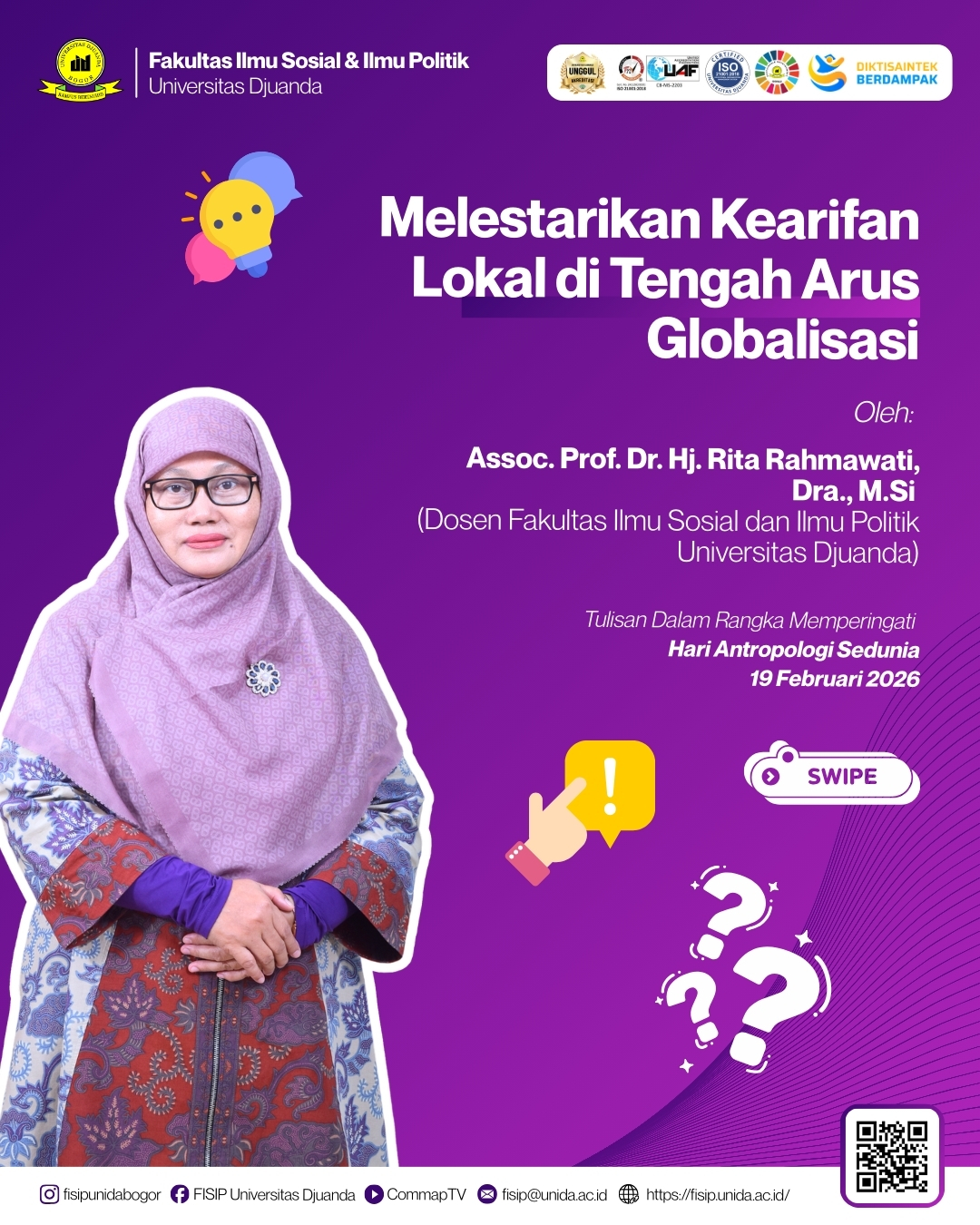
By: Assoc. Prof. Dr. Hj. Rita Rahmawati, Dra., M.Si
(Lecturer, Faculty of Social and Political Sciences, Universitas Djuanda)
In Commemoration of World Anthropology Day
19 February 2026
Introduction
The pace of globalization has accelerated significantly in line with advances in information and communication technology. The presence of the internet, social media, and various digital platforms has eliminated spatial and temporal boundaries, enabling the rapid exchange of information, values, and culture across the globe. Global popular culture—such as music, films, fashion, and lifestyles—can be easily accessed and adopted by diverse groups, particularly among younger generations. Consumption patterns, modes of communication, and lifestyle choices are increasingly shaped by global trends. On one hand, globalization offers opportunities for progress and broader connectivity; on the other, it poses challenges to the preservation of local identities and cultural values, which risk becoming increasingly marginalized.
The impact of globalization is increasingly evident in the tendency toward cultural homogenization across different regions. Clothing styles, entertainment preferences, consumption habits, and social interactions are becoming more uniform, gradually displacing the uniqueness of local cultures that once defined communities. At the same time, the use of local languages is declining, especially among younger generations who prefer national or foreign languages in daily communication. Local traditions and cultural practices—such as customary rituals, traditional arts, and values of mutual cooperation—are also beginning to fade or are practiced merely symbolically, without a deep understanding of their meaning. This phenomenon reflects a cultural shift that, if not properly addressed, may threaten the resilience of identity and the preservation of local cultural heritage.
Amid these rapid changes, local wisdom serves as an essential pillar in preserving national identity. The values embedded in traditions, languages, customs, and social practices not only reflect cultural identity but also represent collective perspectives, knowledge, and wisdom that have stood the test of time. Local wisdom functions as a social force that strengthens solidarity, social resilience, and the community’s ability to adapt to change without losing its cultural roots. Therefore, preserving and revitalizing local wisdom is not merely an effort to safeguard the heritage of the past, but also a strategic step toward strengthening national character in the face of globalization.
The Meaning and Strategic Value of Local Wisdom
Local wisdom can be understood as the entirety of knowledge, norms, values, and cultural practices that develop within a society and are passed down from generation to generation. This wisdom emerges from a community’s long experience in interacting with its physical, social, and cultural environment, thus embodying contextual knowledge that is adaptable to local conditions. It manifests in the form of traditions, customs, languages, belief systems, natural resource management practices, and communal ways of life that emphasize harmony and balance. Because it is rooted in shared experiences and noble values, local wisdom functions not only as a guide for living but also as a reflection of a community’s identity and character.
Local wisdom plays various significant roles in community life, encompassing social, cultural, and environmental dimensions. Socially, it serves as a guideline for fostering balanced relationships between individuals and groups through values such as mutual cooperation, deliberation, and mutual respect. From a cultural perspective, local wisdom contributes to the preservation of community identity and character amid the dynamics of change. In the environmental realm, many local wisdom practices regulate the wise and sustainable use of natural resources, thereby helping to maintain ecological balance. Moreover, local wisdom acts as social capital that enhances community resilience in facing social, economic, and environmental challenges.
The Challenges of Globalization to Local Wisdom
Globalization brings serious challenges to the sustainability of local wisdom within society. The rapid flow of global information and culture through digital media and the entertainment industry triggers shifts in values, mindsets, and lifestyles that tend to favor foreign cultures. As a result, younger generations are becoming less familiar with, less understanding of, and less engaged in the local traditions and values inherited from their ancestors. Furthermore, urbanization and modernization have weakened social ties and disrupted intergenerational cultural transmission. At the same time, cultural commercialization often transforms traditions into mere entertainment or economic products, neglecting their underlying philosophical meanings. If these conditions are not addressed seriously, they may lead to the erosion of cultural identity and the loss of local wisdom that constitutes a valuable national asset.
One factor accelerating the decline of local wisdom is the diminishing availability of spaces and support for cultural practices within communities. Development processes that focus heavily on modernity are often not accompanied by the provision of spaces for traditional cultural expression. Public spaces, social agendas, and educational activities have yet to fully support the preservation of local arts, languages, and traditions. In addition, policy support, funding, and capacity-building for cultural communities remain limited and unsustainable. This situation makes it difficult for cultural practitioners to maintain the continuity of their activities, while fewer young people are involved in local cultural practices. Without adequate space and consistent support, local wisdom is increasingly marginalized in modern social life.
Preservation Strategies in the Global Era
The preservation of local culture in the era of globalization must be pursued through flexible and adaptive approaches, without undermining its fundamental meanings and values. An initial step can be taken by strengthening education as a means of intergenerational cultural transmission. Integrating local cultural content into curricula, developing extracurricular activities, and implementing learning models grounded in local wisdom can enhance awareness and pride among younger generations regarding their cultural identity. At the same time, government policies across various sectors should more thoroughly consider local cultural values in development planning and implementation. Families and communities also play a crucial role in introducing local languages, traditions, and social values—such as mutual cooperation, deliberation, and solidarity—from an early age, ensuring that culture remains embedded in daily life.
Alongside societal advancement, the use of digital technology has become a crucial strategy for ensuring the sustainability of local culture amid the pressures of globalization. The digitization of cultural archives, promotion of arts and traditions through social media, and development of creative content based on local culture can broaden access and enhance appeal, particularly among younger generations. These efforts need to be supported by government policies that protect cultural heritage, provide funding for cultural activities, and empower local communities. In this way, cultural preservation becomes more than symbolic or ceremonial; it is genuinely integrated into social life and generates added economic value through the development of tourism and the creative economy.
Conclusion
Ultimately, the future of a nation depends not only on its ability to keep pace with global developments, but also on its capacity to preserve and nurture its own cultural traditions. Local wisdom should not be viewed as a rigid legacy of the past, but as a dynamic source of values capable of adapting to changing times. By combining a strong cultural identity with openness to innovation and transformation, Indonesian society can progress as a modern community without losing its authentic identity. Preserving cultural roots while engaging with the global stage is not a contradictory choice; it is the key to creating a future that is rich in character, resilient, and sustainable.