
Last Updated: 1 month ago
A total of 106 students from the Faculty of Social and Political Sciences (FISIP) at Universitas Djuanda (UNIDA) are set to participate in the Community Service Program (Kuliah Kerja Nyata/KKN) across nine villages in Cigombong District, Bogor Regency. As part of the implementation of UNIDA’s Pancadarma principles, the program aims to strengthen village governance, empower local communities, and support sustainable rural development.
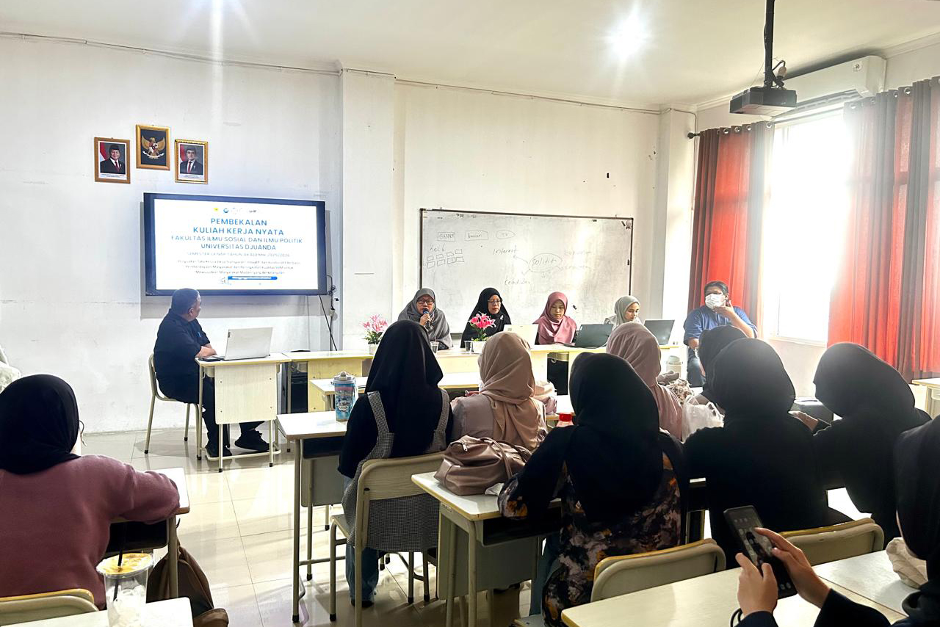
The Community Service Program for the Even Semester of the 2025/2026 Academic Year carries the theme, “Strengthening Transparent, Innovative, and Collaborative Village Governance Through Community Empowerment and Human Resource Development to Foster a Sustainable Civil Society.” A program orientation session was held on Wednesday, June 10, 2026, attended by the Dean of FISIP UNIDA, Assoc. Prof. Dr. Hj. Rita Rahmawati, Dra., M.Si., along with the Vice Deans, Heads and Secretaries of Study Programs, and the Head of the Laboratory.
Dean of FISIP UNIDA, Assoc. Prof. Dr. Hj. Rita Rahmawati, Dra., M.Si., emphasized that the Community Service Program serves as a learning platform that provides students with hands-on experience in applying their academic knowledge while contributing to community development.
“KKN is not only a medium for community engagement but also an opportunity for students to develop both hard and soft skills, strengthen leadership and collaboration abilities, and enhance their awareness of social issues within society,” she stated.
Assoc. Prof. Dr. Hj. Rita Rahmawati further noted that the experience gained during the program would serve as valuable preparation for students as they face future professional and social challenges.
“We hope that FISIP UNIDA students will be able to apply their knowledge in real-world settings, build collaboration with local communities and village governments, and contribute to creating independent, participatory, and sustainable development,” she added.
Meanwhile, the Vice Dean for Academic Affairs of FISIP UNIDA, Assoc. Prof. Dr. Saprudin, M.Si., explained that the 2026 Community Service Program participants consist of 36 students from the Public Administration Study Program and 70 students from the Communication Science Study Program. They will carry out their community service activities in Ciadeg, Ciburayut, Ciburuy, Cigombong, Cisalada, Pasirjaya, Srogol, Tugujaya, and Watesjaya Villages.
The program will focus on five key areas: strengthening transparent and accountable village governance, community empowerment based on local potential, improving the quality of village human resources, enhancing collaboration and community participation, and fostering the development of a sustainable civil society.
“Students are expected to become partners of the community by offering innovative solutions through collaborative and participatory approaches, ensuring that the programs implemented provide long-term benefits for the villages,” he explained.
Throughout the program, students will implement various initiatives tailored to community needs and village potentials. These activities include training in village administration and digital archiving, digital marketing assistance for micro, small, and medium enterprises (MSMEs), digital literacy training, tutoring programs for children, youth leadership development, and participatory development planning forums.
Through these initiatives, students are expected to contribute to improving public service quality, strengthening community capacity, and encouraging inclusive and sustainable village development.
The Community Service Program is scheduled to take place from July 27 to August 27, 2026. Prior to deployment, participants attended an orientation session on June 10, 2026, as part of their preparation. The entire program will conclude with a Community Service Workshop on September 3, 2026, serving as a forum for disseminating the outcomes of students’ community engagement activities.
In addition to providing direct benefits to local communities, the FISIP UNIDA Community Service Program is also designed to generate various academic outputs. These include community service reports, opinion articles, community engagement journal articles, mass media publications, Intellectual Property Rights (IPR) outputs in the form of activity posters, documentary videos, and innovation proposals that can support sustainable village development.