
Last Updated: 7 months ago
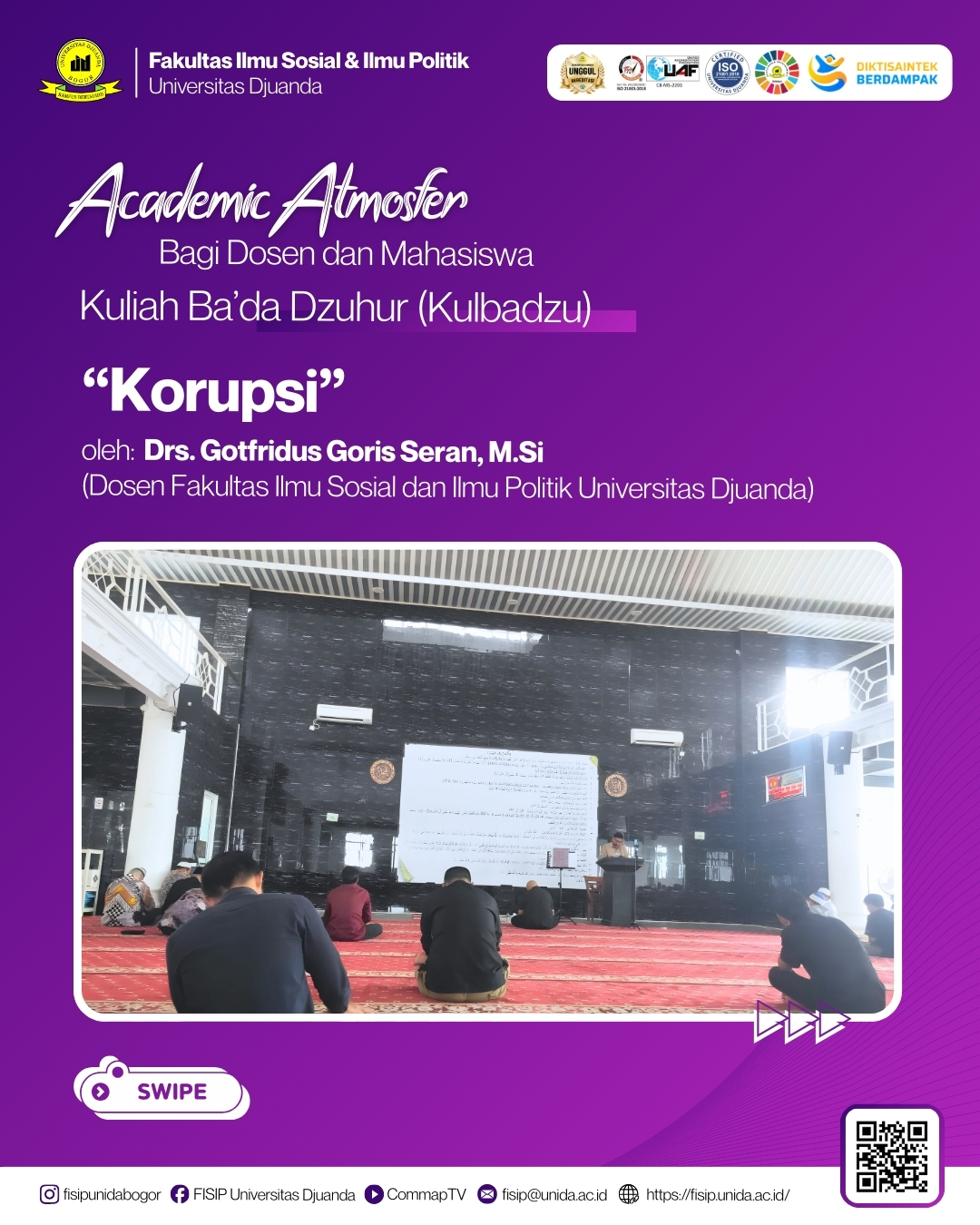
Academic Atmosfer for Lecturer and Students
Kuliah Ba'da Dzuhur (Kulbadzu)
"Corruption"
By:
Drs. Gotfridus Goris Seran, M.Si
Tuesday, Desember 9, 2025
Bismillahirrahmanirrahim
Assalamu’alaikum warahmatullahi wabarakatuh,
Let us offer our praise and gratitude to Allah SWT. By His blessings and mercy, we remain steadfast in faith and Islam.
May peace and blessings be upon the Prophet Muhammad SAW, his family, his companions, and all of us as his followers.
Today, December 9, coincides with the International Anti-Corruption Day. The following day, December 10, the world also commemorates Human Rights Day.
Recently, the Indonesian nation has been struck by severe natural disasters: floods and landslides in Aceh, North Sumatra, and West Sumatra.
In linking these two commemorative moments—Anti-Corruption Day and Human Rights Day—with the occurrence of natural disasters in Sumatra, I raise the topic of CORRUPTION.
The word corruption (Indonesian: korupsi) originates from the English noun corruption, which is derived from the Latin nouns corruptio or corruptus. These, in turn, come from the Latin verb corrumpere, meaning to rot, damage, bribe, destroy, or deviate.
In Islamic terminology, corruption is comparable to:
These five Islamic terms converge on the etymological meaning of corruption: al-fasad, which refers to destruction, decay, disorder, or moral degradation. This meaning encompasses violations of religious teachings, moral law, social order, and even environmental destruction, as mentioned in the Qur’an in the context of fasad fil ardh (corruption on earth).
According to external assessments (Transparency International, 2024), Indonesia has a low Corruption Perceptions Index, scoring 37 (on a scale of 0 = highly corrupt to 100 = very clean), ranking 115 out of 180 countries worldwide.
Corruption in Indonesia at the national level over recent years has reached an extraordinary scale (mega-corruption), amounting to approximately IDR 1,613.9 trillion (or IDR 1.6 quadrillion). This includes cases involving Pertamina (IDR 968.5 trillion), PT Timah (IDR 300 trillion), BLBI (IDR 138 trillion), Duta Palma (IDR 78 trillion), PT TPPI (IDR 37 trillion), PT ASABRI (IDR 22 trillion), PT Jiwasraya (IDR 17 trillion), the Ministry of Social Affairs (IDR 17 trillion), Palm Oil CPO (IDR 12 trillion), Garuda Indonesia (IDR 9 trillion), BTS at the Ministry of Communication and Information Technology (IDR 8 trillion), and Bank Century (IDR 7 trillion).
Corruption occurs in the public sector due to greed (among leaders), collusion, and nepotism (between rulers and business elites), resulting in policies that tend not to favor public interests. The disasters in Sumatra are viewed as consequences of misguided public policies.
Contradictions in government policies—operating without a clear vision—have emerged: tax collection from citizens, public levies, the election of regional heads by local legislatures, and others, all justified by claims of fiscal incapacity in the state budget (APBN).
However, on the other hand, state funds are being massively embezzled. If calculated properly, the funds lost to corruption should have been used to provide free basic services in EDUCATION (at least primary to secondary education) and HEALTHCARE.
Therefore, it is appropriate for us to pursue CITIZEN SUITS or CLASS ACTIONS against the Government.
From an Islamic perspective, the Qur’an explicitly prohibits corruption through two main prohibitions:
Allah SWT affirms this in the Qur’an:
In essence, these verses:
A trustworthy leader (amanah):
These qualities require leaders to be honest, fair, and accountable.
When choosing leaders, the people do not relinquish all their power. Part of that power remains with the people, so that they—as the source and owners of sovereignty—continue to supervise their leaders, ensuring that leaders uphold and carry out the people’s mandate.
Akhirul kalam,
Wassalamu’alaikum warahmatullahi wabarakatuh.
Ciawi, Tuesday, December 9, 2025
Gotfridus Goris Seran