
Last Updated: 6 months ago
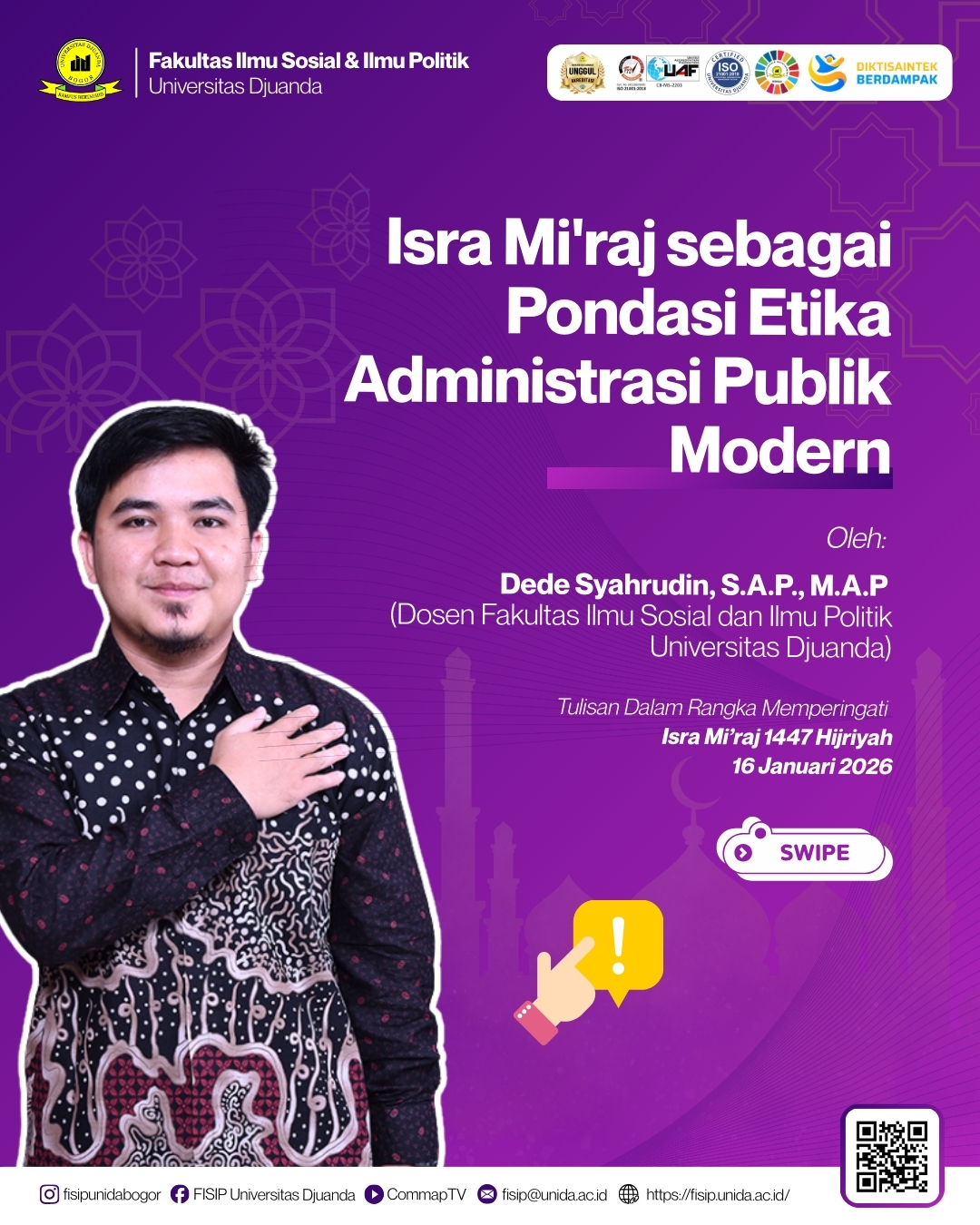
Dede Syahrudin, S.AP., M.AP (Lecturer, Faculty of Social and Political Sciences, Universitas Djuanda)
Friday, January 16, 2026
The event of Isra Mi’raj is one of the most important spiritual moments in Islam, not only related to aspects of faith and ritual but also containing epistemological, ethical, and civilizational dimensions. In the Islamic scholarly tradition, Isra Mi’raj is regarded as al-waqi’ah al-kubrā (the great event) that affirms the vertical relationship between humans and God while simultaneously radiating ethical consequences for the horizontal relationships among humans and with the social structure.
While in the realm of tafsir and kalam, Isra Mi’raj is understood as evidence of prophethood and the legitimacy of apostleship, in the socio-political and public administration perspective it can be interpreted as a moment of institutionalizing values—especially through the revelation of the command to perform prayer. This command essentially symbolizes normative discipline, moral awareness, and regulatory order rooted in spiritual integrity. Therefore, the interpretation of Isra Mi’raj should not remain confined to the ritual dimension (ubudiyah), but should move toward the social (mu’āmalah) and governance (siyāsah) dimensions, especially amid the challenges of modern public administration that faces increasing complexity, integrity crises, and global pressures demanding bureaucracies to be more adaptive, transparent, and accountable.
This paper seeks to actualize the moral message of Isra Mi’raj as a normative foundation for strengthening ethics in modern public administration, such that religious values do not remain limited to the private domain, but also serve as a scientific framework, national reference, and civilizational development orientation.
Isra Mi’raj is not merely a physical and spiritual journey of Prophet Muhammad (PBUH), but an event of value institutionalization with implications for the formation of public morality. Three important lessons can be directly connected to the concept of modern public administration:
The concept of amanah in Islam is not only about interpersonal interaction but is also part of the ethical structure of power. God says:
“Indeed, Allah commands you to return the trust to whom they are due...” (Qur’an 4:58)
In public administration terminology, amanah intersects with three pillars of ethics: positional integrity, transparency of authority, and accountability of responsibility. This principle is equivalent to the concept of public interest in Western administrative theory and aligns with the idea of fiduciary duty in modern organizational governance.
Thus, amanah can be understood as an ethical capital for good governance, ensuring that power is positioned as a public mandate, not a means of domination.
Justice (al-‘adl) is the core of the prophetic mission and serves as the ethical basis of social structure. God says:
“O you who believe! Be persistently standing firm for Allah, witnesses in justice...” (Qur’an 5:8)
In public administration, justice is translated into principles of equity, fairness, and equal access to public services. Justice is not only a matter of the legal system but also of bureaucratic behavior in ensuring public services that are inclusive, non-discriminatory, and rights-based.
Thus, Isra Mi’raj lays not only spiritual devotion but also structural justice that operates through public institutions.
The command to perform prayer revealed during Mi’raj symbolizes disciplinary governance, that is, self-regulation through awareness rather than coercion. The Prophet said:
“Prayer is the pillar of religion.” (Tirmidhi)
Prayer teaches punctuality, procedural commitment, and self-control. In the framework of modern public administration, this aligns with compliance ethics, the idea that an ideal bureaucracy adheres to regulations not only due to threat of punishment (regulatory compliance) but due to moral awareness (ethical compliance).
In other words, Mi’raj emphasizes that good governance cannot stand without good citizens and an ethical bureaucracy.
Contemporary public administration faces three major challenges that erode citizens’ trust in the state:
The values of Isra Mi’raj can be contextualized to address these challenges.
Corruption in Islamic perspective is ghulul, betrayal of public trust. The Prophet said:
“Whoever commits ghulul will come on the Day of Judgment carrying what he stole.” (Muslim)
This concept expands the definition of corruption beyond administrative violations; it becomes a social sin because it destroys social capital and civic trust—foundations of state stability.
The eras of New Public Management (NPM) and Open Government demand openness, public audits, and accountability mechanisms. Islam has long taught the principle of hisab (divine accountability):
“...And sufficient is Allah as the Reckoner.” (Qur’an 4:6)
This dual accountability—both earthly and divine—can strengthen public service ethics and build trust-based governance, now a key governance indicator in OECD countries.
In Islam, power exists not for domination but for serving society. The Prophet said:
“The leader of a people is their servant.” (Tabarani)
This aligns with the New Public Service (NPS) paradigm, placing public service as a means to achieve civic outcomes rather than simply bureaucratic efficiency.
As a nation with a religious-constitutional identity, Indonesia requires synthesis between moral values and modern administrative science. Public ethics cannot rely solely on legal instruments, as positive law is coercive while ethics is internalized.
Three areas of actualization include:
The world faces three global phenomena:
International organizations such as OECD, UNDP, and the World Bank emphasize:
Remarkably, these values have long existed within Islamic tradition—through amanah, ‘adl, hisab, and khidmah. Islam can thus serve not only as political identity but as a source of governance ethics compatible with global norms.
Connecting Isra Mi’raj with public administration ethics is not theological romanticism, but an effort to integrate knowledge and illuminate public understanding. This approach positions Islam not merely as ritual practice but as moral guidance for modern governance, both nationally and globally.
In this context, the Faculty of Social and Political Sciences (FISIP) of Universitas Djuanda holds a strategic role to:
Thus, commemorating Isra Mi’raj becomes not merely a religious ritual but a moment of knowledge reproduction, national reflection, and scholarly contribution aligned with constitutional mandates, academic missions, and the moral demands of society and the nation.