
Last Updated: 6 months ago
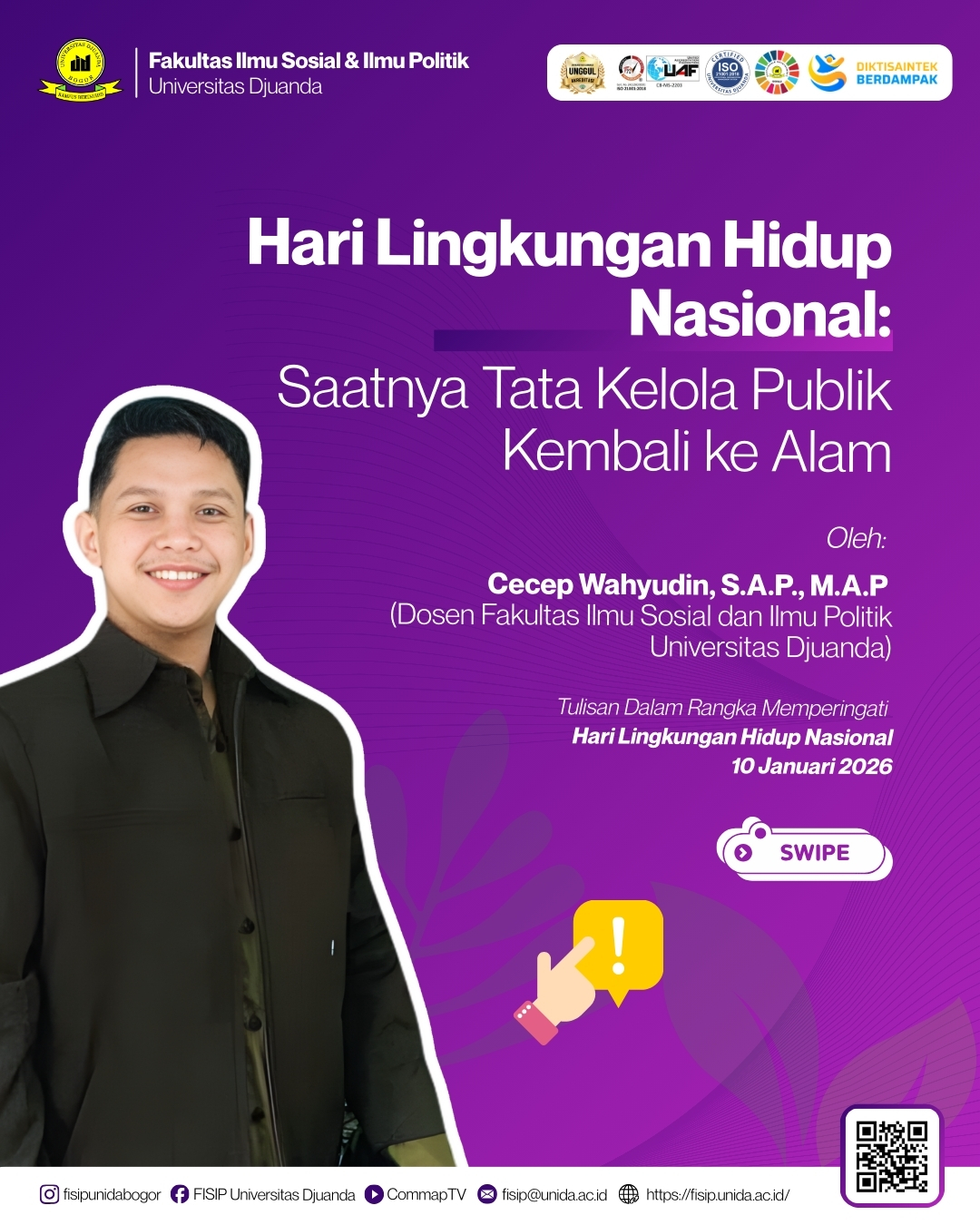
By: Cecep Wahyudin, S.A.P., M.A.P (Lecturer, Faculty of Social and Political Sciences, Djuanda University)
Indonesia’s Environmental Day serves as a reflective moment to examine how the state, government, and society treat nature as the foundation of life rather than merely an object of policy. From a public administration perspective, public governance must position the environment as a central subject of policy, not as a neglected by-product. This is not mere idealism, but a constitutional obligation affirmed in Article 33 paragraph (3) of the 1945 Constitution, which recognizes the right to a good and healthy environment as part of the right to natural resources controlled by the state for the greatest prosperity of the people.
Normatively, environmental management in Indonesia is regulated by Law Number 32 of 2009 on Environmental Protection and Management (PPLH Law), which emphasizes the precautionary principle, public participation, and intergenerational justice. Furthermore, derivative regulations such as Government Regulation No. 22 of 2021 on the Environmental Protection and Management Plan (RPPLH) require each region to formulate a strategic plan (Renstra) that incorporates green governance into regional development planning. The pursuit of the Sustainable Development Goals (SDGs) also encourages the integration of green governance policies into governmental administration.
Existing realities indicate that although environmental policies are comprehensive, their implementation has yet to meet established targets. Massive deforestation continues through plantation expansion, mining activities, illegal logging, forest and land fires, urban air pollution, and marine waste accumulation. These issues reflect weak inter-agency coordination, inadequate administrative law enforcement, and low levels of public participation in public decision-making. In many regions, development planning still prioritizes short-term economic growth without sufficient respect for ecological limits.
Governance theory in public administration emphasizes collaboration among the state, the market, and civil society. In the context of green governance, this means that environmental management should not be the sole responsibility of environmental agencies, but rather a cross-sectoral and multi-actor issue. The concepts of collaborative governance and network governance demonstrate that effective coordination, transparency, accountability, and active public participation are the foundations of successful and sustainable environmental policies.
A concrete example of both challenges and opportunities in green governance is the waste management program in Bogor City. The city faces increasing waste volumes alongside rapid urbanization. The municipal government has introduced policies such as banning single-use plastic bags and developing community-based waste banks. Analysis from a public administration perspective shows that these programs succeed when supported by strong institutional capacity building, meaningful public participation in decision-making, and regulatory continuity backed by adequate resources. Nevertheless, challenges remain, including low environmental awareness and weak cross-sectoral coordination.
Based on policy implementation theory, the success of environmental policies depends on three main elements: (i) policy design that is responsive to local contexts, (ii) strong organizational capacity in implementation, and (iii) effective relationships among actors. A sustainable governance approach requires adaptive management—governance that is able to learn, adjust to environmental dynamics and public aspirations, and integrate policies both horizontally (across sectors) and vertically (between central and local governments). This aligns with the concept of smart governance, which promotes the use of information technology to enhance transparency and collaboration in environmental governance.
Indonesia’s Environmental Day should become a transformative moment for public governance that truly returns to nature. The government must strengthen evidence-based regulations, expand public participation and cross-sectoral collaboration, and reinforce administrative oversight and sanctions against environmental violations. Academics, practitioners, and communities must act as co-governors in realizing sustainable development that goes beyond rhetoric. Through active collaboration and a scientific approach to public policy, Indonesia can move from mere green rhetoric toward genuine and accountable green governance for the welfare of present and future generations.