
Last Updated: 2 months ago
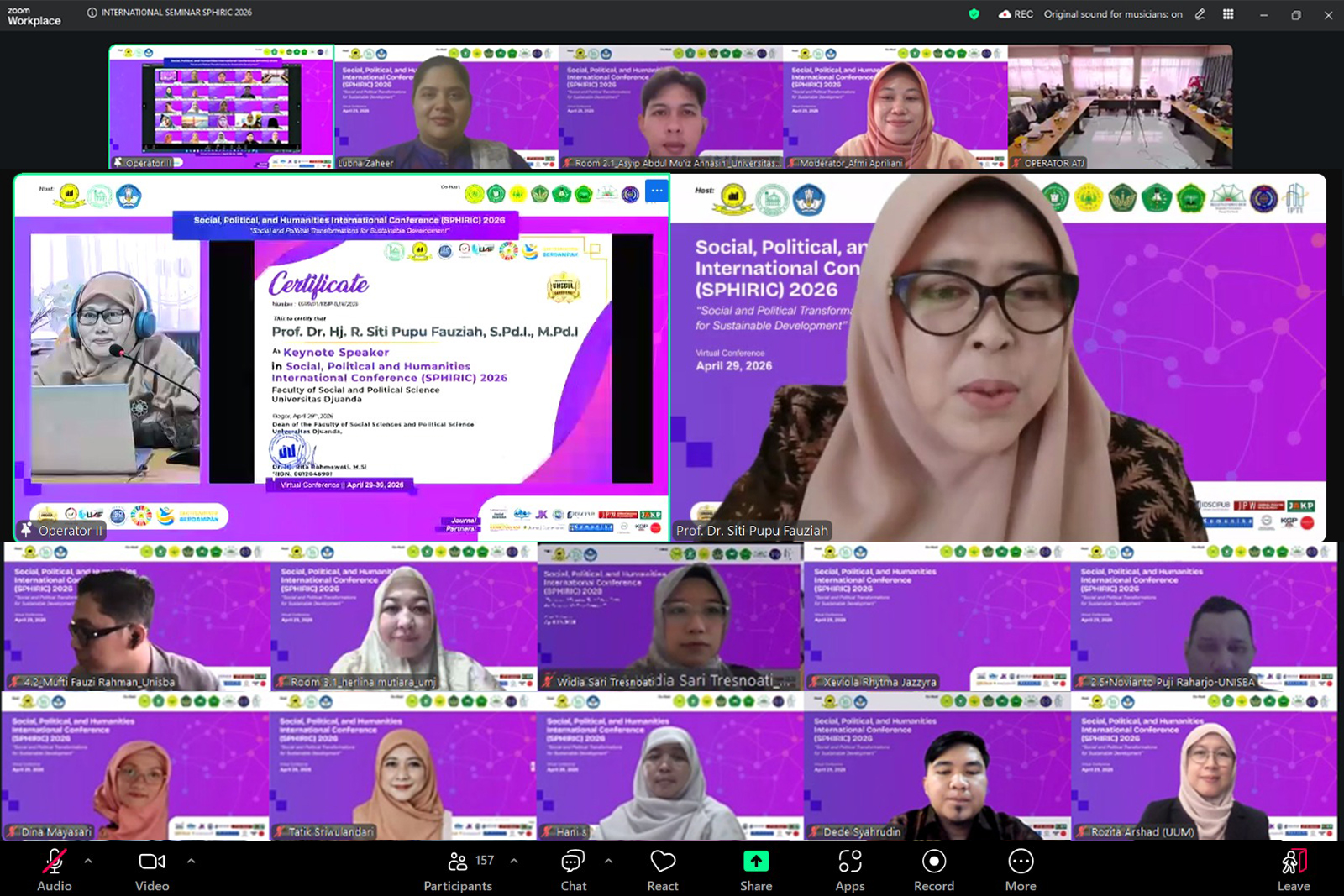
Bogor – The Faculty of Social and Political Sciences (FISIP) at Universitas Djuanda successfully organized the Social, Political, and Humanities International Conference (SPHIRIC) 2026 virtually on April 29, 2026. Carrying the theme “Social and Political Transformations for Sustainable Development,” the international conference served as a strategic forum that brought together academics, researchers, students, and practitioners from various countries to exchange ideas and present the latest research findings in the fields of social sciences, politics, and humanities.
SPHIRIC 2026 received broad enthusiasm from both national and international academic communities. A total of 255 participants from 57 institutions took part in the conference, consisting of 241 presenters and 14 non-presenters. Through this event, FISIP UNIDA encouraged the production of high-quality scientific publications, including international proceedings, nationally accredited journals, and Scopus-indexed book chapters published by UPM Press.
SPHIRIC 2026 was organized by FISIP Universitas Djuanda (UNIDA) in collaboration with nine co-host institutions: Universitas Muhammadiyah Jakarta, Universitas Mathla’ul Anwar Banten, Universitas Pakuan, Universitas Ibn Khaldun Bogor, Sekolah Tinggi Pariwisata Bogor, Universitas Lancang Kuning, IISIP YAPIS Biak, Institut Pariwisata Tedja Indonesia, and Universitas Muhammadiyah Palopo.
Dean of FISIP UNIDA and Chairperson of SPHIRIC 2026, Assoc. Prof. Dr. Hj. Rita Rahmawati, stated that the conference reflected the faculty’s commitment to strengthening global academic networks and providing a productive platform for scientific dialogue.
“This conference was organized to discuss the latest international research findings in the fields of social sciences, politics, and humanities, while also building strong networks among students, lecturers, researchers, and practitioners from various countries,” she stated.
She added that the conference theme was chosen in response to global challenges that require cross-disciplinary and cross-country collaboration.
Meanwhile, Chancellor of Universitas Djuanda, Prof. Dr. Martin Roestamy, emphasized in his remarks that universities bear significant responsibility as centers for scientific development and providers of solutions for society.
“Universities must be present not only as educational institutions, but also as centers of solutions to social, political, and humanitarian issues through collaborative research with real impact,” he affirmed.
According to him, international forums such as SPHIRIC play an important role in bringing together progressive ideas relevant to the needs of global society.
On the same occasion, Rector of Universitas Djuanda, Prof. Dr. Hj. R. Siti Pupu Fauziah, attended as the Keynote Speaker and delivered a presentation entitled “Reimagining Guidance and Counseling Management: A Human Resource Development Approach to Achieve the SDGs.” In her presentation, she highlighted the importance of transforming guidance and counseling management to become more adaptive to contemporary developments and oriented toward human resource development.
“Guidance and counseling management must transform from an administrative approach into a strategic system that is data-driven, adaptive, and integrated with sustainable development needs,” she explained.
She also stated that strengthening such systems contributes to improving educational quality, mental health, and youth workforce readiness in alignment with the Sustainable Development Goals (SDGs).
In addition to the keynote speaker, the conference featured five international speakers: Assoc. Prof. Dr. Rozita Arshad from the School of Government, Universiti Utara Malaysia, who presented “Integrating Entrepreneurship and Public Policy in Urban Development”; Prof. Seung Hwan Myeong from Inha University, South Korea, with the topic “Digital Bureaucracy and Citizen Participation”; Prof. Tomoyasu Sano from Sapporo Gakuin University, Japan, with “Clinical Psychological Considerations for People Who Cannot Adapt to Change: Supporting the Return to Work of Patients with Depression”; Prof. Lubna Zaheer from Punjab University, Pakistan, with “Media, Democracy and Public Trust”; and Dr. Puvaneswaran Kunasekaran from Universiti Putra Malaysia, with “Tourism as a Sustainable Community Development Tool for Indigenous People in Malaysia.” All plenary sessions were moderated by Afmi Apriliani, who guided the academic discussions interactively and dynamically.
The conference series proceeded dynamically through plenary sessions, academic discussions, cooperation agreement signings with co-host institutions, and participants’ parallel presentations. The event demonstrated that SPHIRIC 2026 served not only as a platform for scientific exchange, but also as a concrete forum for expanding strategic collaboration among universities and institutions at the international level.
Through the organization of SPHIRIC 2026, FISIP UNIDA reaffirmed its commitment as a higher education institution actively expanding global networks, improving the quality of scientific publications, and encouraging academic contributions toward sustainable development. Moving forward, the conference is expected to continue becoming a flagship agenda that generates innovation, collaborative research, and real solutions for communities in Indonesia and around the world.