
Last Updated: 1 year ago
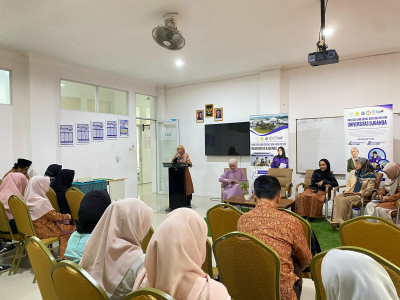
The Faculty of Social and Political Sciences (FISIP) at Djuanda University (Unida) once again held its signature Ramadhan activity, the second edition of its Ramadhan Lecture (Kurma) and Talks on Piety (Onta), on Friday, March 21, 2025.
The event, which took place in FISIP Room 303, was attended by lecturers, staff, and students who actively participated in the discussion on the theme "Enjoining Good and Forbidding Wrong in Public Administration and Communication Science."
Dean of FISIP Unida, Dr. Rita Rahmawati, stated that the Kurma and Onta activities are tangible proof of FISIP Unida's commitment to filling the month of Ramadhan with beneficial activities. Furthermore, the 2025 Kurma and Onta series also serves to celebrate the 38th Anniversary of Djuanda University.
"Hopefully, through the Kurma and Onta activities, we can all fill the month of Ramadhan with knowledge that is full of benefits for our lives," said the Dean, who is affectionately known as Rara.
In her presentation, Agustina Multi Purnomo emphasized that the media plays a crucial role in voicing what is right. According to her, students must be wise in using media to disseminate correct information.
"Teaching goodness must be done with good communication skills. Spreading truth must be done in the right way. The media is a tool that can be used to voice what is right, but it must always be based on facts and scientific arguments," she said.
Meanwhile, Nadia Amalia asserted that Islam is a religion that brings peace, and the concept of 'Enjoining Good and Forbidding Wrong' is closely related to ethical communication.
Next, Ginung Pratidina highlighted the role of organizations in shaping the country's social conditions and policies. She reminded the audience that the principle of 'Enjoining Good and Forbidding Wrong' must also be applied in governance.
"Our country is not doing well right now, and one of the causes is the policies implemented by certain organizations. If the principle of 'Enjoining Good and Forbidding Wrong' were applied properly, the resulting policies would be more just in their application and would side with the people," she explained.
In the same discussion, Neng Virly Aprliyani highlighted the challenges in implementing the principle of 'Enjoining Good and Forbidding Wrong' in the world of governance. According to her, if this principle were truly applied, there would be no corruption or social inequality.
"The phrase 'Enjoining Good and Forbidding Wrong' is easy to say but difficult to implement. If the government truly applied it, there should be no corruption, poverty, or inequality. However, the current reality, with many corruption cases in the oil, tin, and gas sectors, shows that this principle is not yet fully upheld," she stated.
As the moderator, Afmi Apriliani concluded the discussion by emphasizing that enjoining good and preventing wrong must be done in a good and proper manner.