
Last Updated: 7 months ago
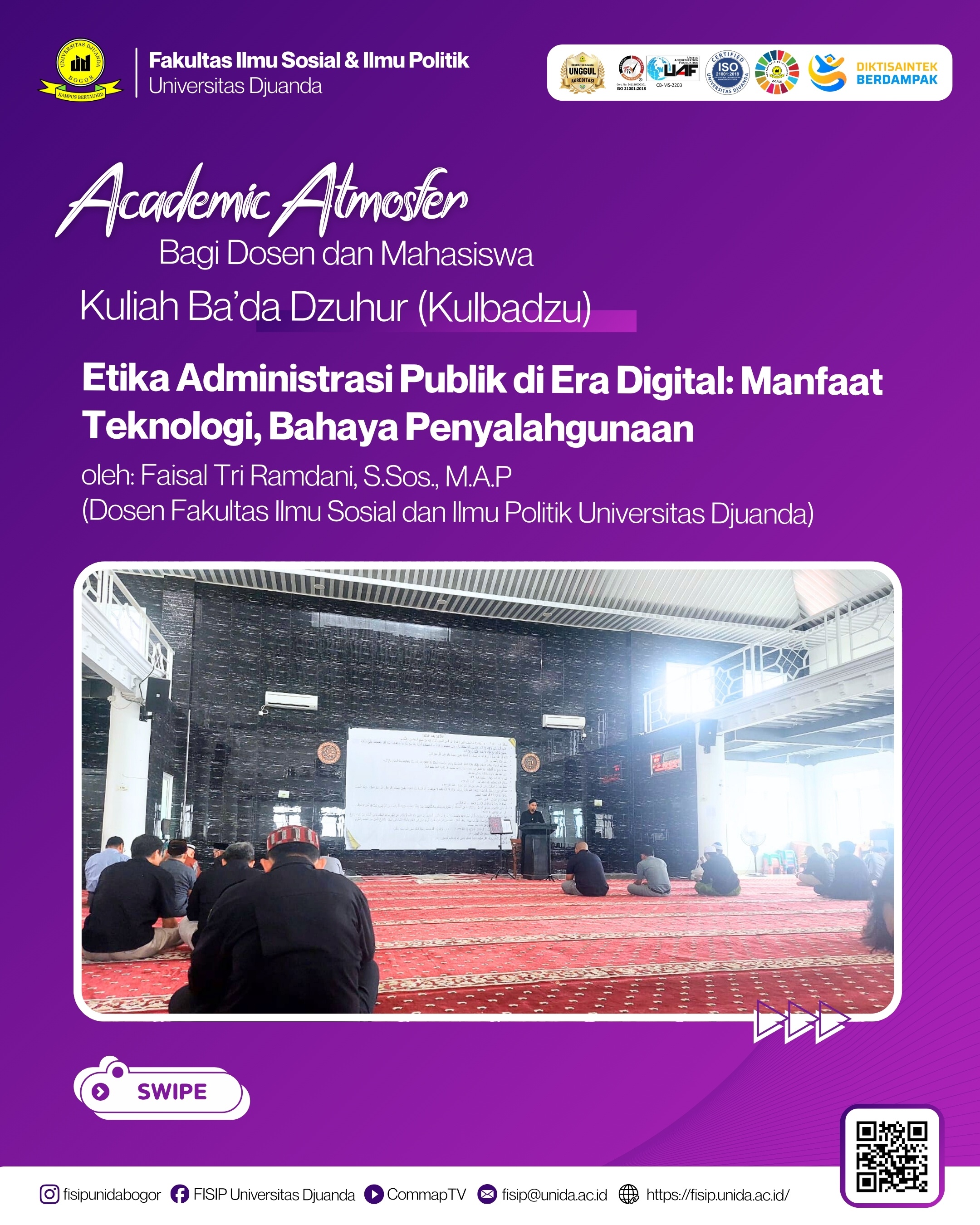
Academic Atmosfer for Lectures and Students
Kuliah Ba'da Dzuhur (Kulbadzu)
Public Administration Ethics In The Digital Era: The Benefits Of Technology And The Dangers Of Misuse
by:
Faisal Tri Ramdani, S.Sos., M.A.P
Wednesday, Desember 17th, 2025
Assalamu’alaikum warahmatullahi wabarakatuh
Bismillahirrahmanirrahim.
“Praise be to Allah, the Lord of all worlds. May peace and blessings be upon the noblest of the prophets and messengers, our Prophet and beloved Muhammad, upon his family and companions, and upon those who follow them in goodness until the Day of Judgment. Amma ba’du.”
Honorable and respected Chancellor of UNIDA,
Chairman of YPSPIAI and all members,
Rector and all members of the leadership,
Leaders within the UNIDA environment,
Lecturers,
Students,
And all congregants of Baitul Hamdi Mosque who are blessed by Allah SWT.
Alhamdulillah, this afternoon we are still granted the blessings of health, faith, and righteousness, allowing us to gather in this noble assembly of knowledge at Baitul Hamdi Mosque, Universitas Djuanda, for the Ba’da Dzuhur Lecture.
On this occasion, I am entrusted to deliver a brief lecture entitled “Public Administration Ethics in the Digital Era: The Benefits of Technology and the Dangers of Misuse.”
Islam teaches that every authority is a trust (amanah). In the context of public administration, this trust is not limited to state finances, but also includes citizens’ data, system access, service decisions, and information conveyed to the public. Allah Subhanahu wa Ta’ala reminds us:
“O you who believe, do not betray Allah and the Messenger, nor betray the trusts entrusted to you while you know.”
(QS. Al-Anfal: 27)
This verse establishes a fundamental principle: betraying a trust is a major sin, especially when that trust concerns the livelihood and welfare of many people. Therefore, in the digital era, data breaches, trading personal data, misuse of system access, manipulation of inputs, or misconduct in public services are not merely procedural violations, but also betrayals of trust.
Distinguished audience whom Allah has blessed,
Technology inherently brings great benefits. First, it simplifies public services. People no longer need to travel far or wait in long queues; many matters can be resolved more quickly. Second, technology promotes transparency: digital footprints make work easier to audit and evaluate. Third, technology opens space for participation: the public can submit complaints, suggestions, and oversight through official channels.
However, behind these benefits lie dangers when ethics are weak.
The first danger is the misuse of data and authority. Citizens’ data is like personal honor. If it falls into the wrong hands, it can be used for fraud, extortion, and other harms. Therefore, officials who have system access must realize that they are not merely system operators, but guardians of trust.
The second danger is the dissemination of information without verification. In the digital era, news can go viral within minutes. When governments or public officials spread unverified information, the consequences can be severe: slander, public panic, and loss of trust. Allah commands tabayyun (verification):
“O you who believe! If a wicked person comes to you with news, then verify it, lest you harm people out of ignorance and afterward become regretful.”
(QS. Al-Hujurat: 6)
Tabayyun is not only a personal ethic, but also an institutional one. In public administration, it means validating data before announcing policies, clarifying before accusing, fact-checking before concluding, and ensuring that information issued by officials or official government accounts brings clarity and calm, not confusion.
The third danger is injustice in service delivery. Digitalization must not leave certain groups behind: the elderly, the poor, residents in areas with limited internet access, or those with low digital literacy. If technology makes it easier for the strong while making it harder for the vulnerable, it contradicts the principle of justice. Ethical public administration must ensure inclusive access: assistance, alternative services, and support for those facing difficulties.
Honored audience,
The Prophet Muhammad ﷺ also gave a strong warning about trust. In a well-known hadith, one of the signs of hypocrisy is mentioned:
“…when entrusted, he betrays the trust…”
(Narrated by Bukhari and Muslim)
This is a profound warning. It shows that faith is measured not merely by words, but by responsibility when entrusted with authority. Therefore, anyone working in government—civil servants, regional officials, program managers, system operators, or decision-makers—must make trustworthiness a personal identity, not merely a slogan.
Ladies and gentlemen,
If summarized into practical guidance, public administration ethics in the digital era can be upheld through three simple principles:
Let us remember: technology is like a knife. It can be used to prepare beneficial food, but it can also cause harm if used without moral guidance. Therefore, what matters most is not only technological sophistication, but also moral integrity in safeguarding trust.
Distinguished audience whom Allah has blessed,
May Allah make us servants who are trustworthy, honest, just, and cautious in every decision, especially decisions that affect the welfare of society.
That concludes the Ba’da Dzuhur lecture I can deliver.
“Our Lord, do not let our hearts deviate after You have guided us, and grant us mercy from Yourself. Indeed, You are the Bestower.”
Allah speaks the truth and He guides to the straight path.
Wassalamu’alaikum warahmatullahi wabarakatuh