
Last Updated: 5 months ago
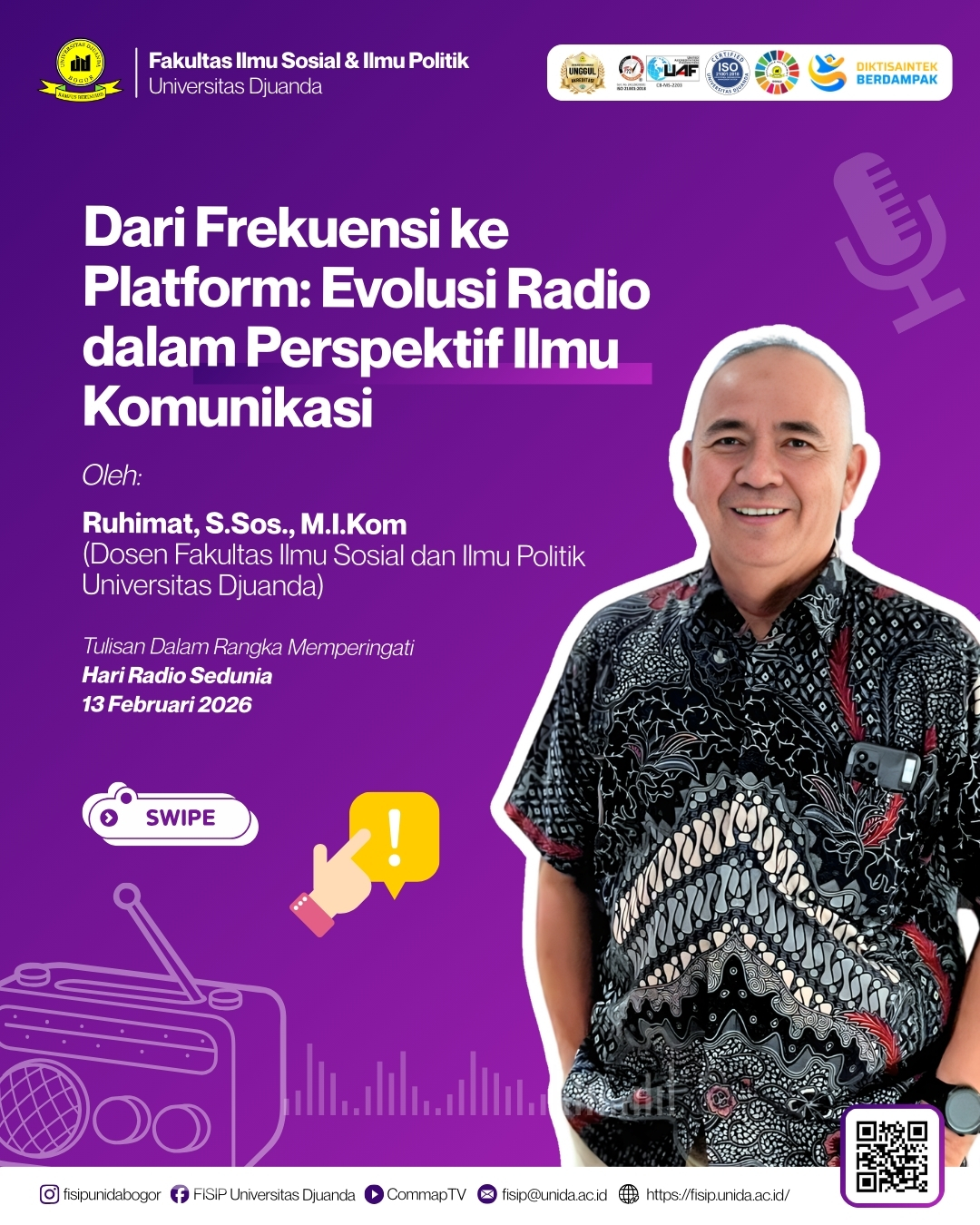
With the theme “Radio and Artificial Intelligence,” the world will commemorate World Radio Day on February 13, 2026. This serves as an urgent call to understand the transformation of radio into a vibrant digital platform powered by artificial intelligence (AI), rather than merely a nostalgic memory of the AM/FM airwaves that once thundered through the skies. From the perspective of communication studies, this change signals a paradigm shift—a transition from one-way broadcasting to an interactive ecosystem that personalizes messages. In this context, classical theories such as the Shannon–Weaver model are becoming increasingly irrelevant.
Imagine the 1920s, the era of radio brought about by the invention of Guglielmo Marconi, which enabled the transmission of Morse signals across the Atlantic. At that time, mass communication relied on limited frequencies, where people passively listened to news, music, or propaganda. One example was BBC broadcasts during World War II. From Marshall McLuhan’s perspective, “the medium is the message,” and radio conveyed collective perception through pure sound. Today, however, AI is rewriting that narrative. Radio has become a “smart companion” that learns from listeners’ habits through platforms such as Spotify and AI-generated podcasts with voice assistants like Grok or ChatGPT. Recommendation algorithms can predict songs you might like based on heart rate data recorded by wearable devices. This creates a personalized experience aligned with Elihu Katz’s uses and gratifications theory, which suggests that audiences now actively participate in content creation.
This evolution is evident in Indonesia. According to Nielsen data from 2025, community radio stations such as Prambors and Gen FM have adopted AI to track listener sentiment in real time through social media, increasing engagement by up to 40%. AI is not only efficient; it also opens opportunities for inclusion—hyperlocal content in rural areas of West Java where FM signals are hard to reach, or synthetic voices in local languages for people with disabilities. However, communication scholars also warn of the looming shadows: echo chambers caused by AI filter bubbles, in which listeners are confined to uniform viewpoints, potentially diminishing radio’s effectiveness as a Habermasian public sphere.
World Radio Day 2026 should be a pivotal moment. To ensure that the evolution from frequencies to platforms does not sacrifice the diversity of voices, regulators such as the Indonesian Broadcasting Commission (KPI) and the Ministry of Communication and Information Technology (Kemenkominfo) must promote ethical AI regulations in radio. Radio is not dead; instead, it has evolved into a medium that connects humans with increasingly intelligent machines. Journalists and communication scholars may see this as an invitation—or risk being left behind on the waves of the past. Happy World Radio Day.