
Last Updated: 4 months ago
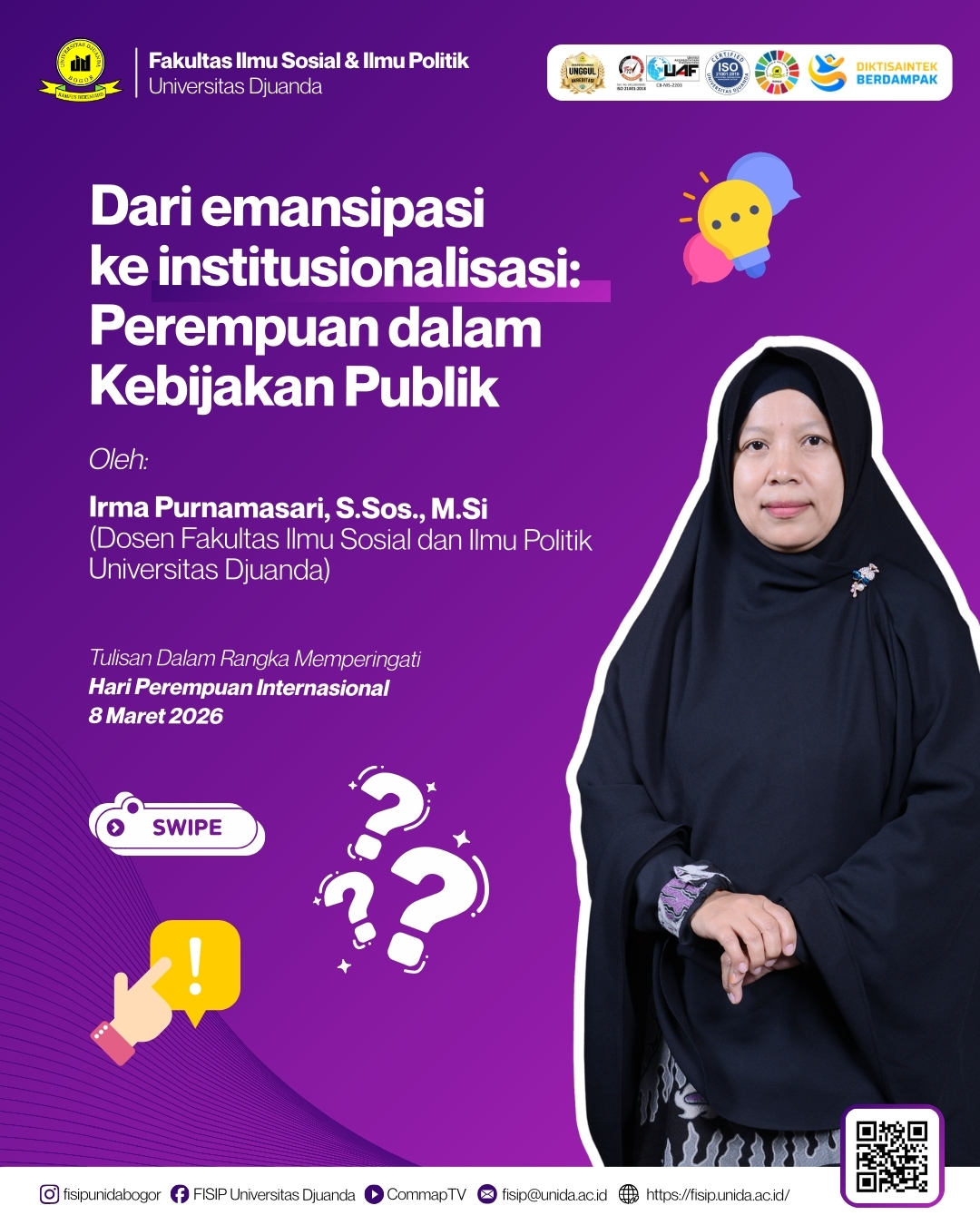
An article written in commemoration of International Women’s Day
By: Irma Purnamasari, S.Sos., M.Si (Lecturer at the Faculty of Social and Political Sciences, Djuanda University)
The role of women in national development has gained increasing recognition across various areas of life, including in the process of formulating and implementing public policy. In the past, women’s struggles were largely focused on demanding basic rights and eliminating discrimination. Today, however, this struggle has progressed to a more advanced stage—ensuring that public policy systems genuinely provide fair and equal opportunities for women.
Within the context of public administration, women’s issues are no longer viewed merely as social concerns but have become an essential component of good governance. The state is required not only to acknowledge gender equality normatively but also to integrate it into development planning, budgeting, program implementation, and policy evaluation processes.
At the global level, commitments to gender equality have been institutionalized through various international agreements, such as the Convention on the Elimination of All Forms of Discrimination Against Women (CEDAW) and the Sustainable Development Goals (SDGs), particularly Goal 5, which emphasizes the importance of gender equality. Indonesia has responded to these commitments through a range of policies, including the establishment of the Ministry of Women’s Empowerment and Child Protection and the implementation of Gender Mainstreaming policies in national and regional development.
However, in public administration practice, the establishment of institutions and regulations does not necessarily guarantee the realization of substantive equality. Major challenges often arise at the stage of policy implementation. Many local governments already possess planning documents that incorporate gender perspectives and have even prepared gender-responsive budgeting statements. Nevertheless, in practice, these policies frequently remain at the administrative level—merely fulfilling reporting requirements without producing tangible improvements in women’s lives.
In public administration studies, this phenomenon is often referred to as symbolic compliance, which denotes formal adherence to policies without substantive transformation in bureaucratic practices. This situation may be caused by several factors, including limited capacity among government officials to conduct gender analysis, institutional fragmentation that leads to women’s issues being perceived as the responsibility of only one agency, and bureaucratic cultures that are still influenced by patriarchal values.
On the other hand, the lack of sex-disaggregated data also poses a significant obstacle to the formulation of gender-responsive policies. Without accurate data, public policy becomes difficult to direct toward addressing the specific needs of women and other vulnerable groups.
In the political context, Indonesia has implemented an affirmative policy in the form of a minimum quota of thirty percent female representation in legislative institutions. This policy represents an important step toward increasing women’s participation in decision-making processes. However, from the perspective of public administration, increased representation does not automatically lead to policies that are more responsive to women’s needs.
Women holding public office must be accompanied by the capacity to formulate evidence-based policies, design gender-responsive budgets, and build accountable policy evaluation systems. Without these measures, women’s representation risks becoming merely a symbol of democracy without delivering tangible impacts on policy change.
In the context of modern governance, opportunities for women to contribute to public policy are also expanding through technological development and government digitalization. The concept of smart governance enables the creation of data-driven development planning systems, greater budget transparency, and broader public participation through digital platforms. When utilized optimally, digital transformation can serve as an important instrument for strengthening more inclusive and gender-responsive policies.
Ultimately, the struggle of women in public policy is no longer limited to demanding recognition of rights but extends to ensuring that governance systems truly operate in a fair and responsive manner. Public administration plays a strategic role as a bridge between the values of social justice and the practical implementation of policies.
From the perspective of modern governance frameworks, the role of women is an integral part of efforts to create a just, prosperous, and civilized society. Therefore, gender equality cannot be pursued merely through discourse and regulations but must be realized through public policies that expand women’s access to education, economic opportunities, and participation in decision-making processes.
Thus, women should not only become the objects of policy but also key actors in shaping the future of national development.