
Last Updated: 1 year ago
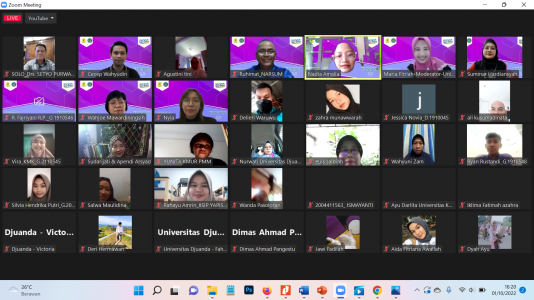
Bogor, October 01, 2022 - The Faculty of Social, Political and Computer Sciences (FISIPKOM) of Djuanda University (UNIDA) Bogor in collaboration with Surakarta University held a Public Relations Communication (KOMPRA) 2.0 webinar with the theme "Healing: The Phenomenon of Toxic Relationship on Mental Health" on Saturday (1/10) at 13.00 WIB, via zoom. In her speech, the Dean of UNIDA's FISIPKOM, Ginung Pratidina, Dra., M.Si, said that one of the activities held was to implement cooperation between UNIDA and Surakarta University. The activity, which was moderated by Maria Fitriah, S.Sos., M.Si, as the non-academic vice dean of FISIPKOM, presented several speakers including Wahjoe Mawardiningsih, S.Sos., M.I.Kom, as a lecturer in Communication Psychology at Surakarta University, Ruhimat, S.Sos., M.I.Kom, as a lecturer in Organizational Communication at UNIDA, and Nila Nirmala, M.Psi, as a practitioner in the field of organizational Industrial Psychology. The first speaker, Ruhimat, S.Sos., M.I.Kom, presented material on toxic relationships and toxic leaders in organizations. At the beginning of the presentation, he explained the definition of organizational communication related to toxic relationships. According to him, a good leader is a leader who is able to take responsibility for the sustainability of the organization he leads and is not thirsty for power and avoids violence against his members in achieving organizational goals. Meanwhile, toxic leaders have bad personalities and can hinder the sustainability of the organization, as evidenced by the destructive behavior they project on their employees. Furthermore, the second speaker, Wahjoe Mawardiningsih, S.Sos., M.I.Kom presented material about social creatures. The presentation began by introducing the characteristics of humans as social creatures, which include always needing other people. social creatures, which include always needing other people. She also explained the causes of toxicity in personal relationships characterized by differences in social status and the failure of the communication process. On the same occasion, the third speaker, Nila Nirmala, M.Psi, as a practitioner in the field of organizational Industrial Psychology, explained about Toxic Behavior. According to her, toxic relationships can arise at any time and happen to anyone. However, toxic can be healed depending on the level of toxicity caused. He also explained the toxic characteristics that individuals unconsciously do to themselves, one of which is difficult to say no to other people to fulfill their demands, including in negative things. According to him, the way to overcome toxic relationships is to dare to refuse something they want.